How to Edit Check Stubs Correctly (2026): Fix Errors Without Faking Anything
- Home
- Blog
- Paystub Generator
- How to Edit Check Stubs Correctly (2026): Fix Errors Without Faking Anything

Fixing a genuine mistake on a pay stub is legal. Altering the numbers to show income you did not earn, or building a fake stub from scratch, is fraud, and it can carry fines, civil liability, and even criminal charges. That one distinction is the whole point of this guide.
Minor mistakes on a check stub are more common than most people think. A misspelled name, a wrong hourly rate, a missed deduction: computer generated or manmade, errors happen. The good news is that correcting them the right way is simple. The safe fix is always to correct the underlying payroll figures and regenerate the stub cleanly, never to doctor a finished PDF. Below, we walk you through exactly how to do that in 2026, how to handle an error that already reached a filed W-2, and how to tell a legitimate stub from a fake.
When It's OK to Edit a Pay Stub (and When It's Fraud)
Start here, because it decides everything else.
- Legal: Correcting a real error so the stub matches what actually happened on payroll. Fixing a typo in a name, a wrong address, an incorrect hourly rate, a missed deduction, or a miscalculated total is legitimate recordkeeping.
- Fraud: Changing the numbers to inflate income, invent hours, or hide deductions, or generating a "realistic" stub for money that was never earned. Presenting an altered stub to a lender, a landlord, or a government agency is misrepresentation.
The consequences are not theoretical. Falsifying income documentation can lead to fines, civil liability, and criminal charges. The rule of thumb is easy to remember: if the edit makes the stub more accurate, you are on solid ground. If it makes the stub say something that did not happen, stop.
Source: U.S. Department of Justice, Justice Manual, False Statements (18 U.S.C. § 1014). Knowingly submitting false information to a financial institution is a federal crime, and presenting falsified income documents to lenders, landlords, or agencies can also trigger state fraud statutes and civil liability.
The Right Way to Fix a Stub: Regenerate, Don't Hand-Edit a PDF
Here is the single most useful tip in this whole article, and the one most people get wrong.
Do not hand-edit a pay stub PDF. When you open a finished PDF and type over a number, the edit leaves behind mismatched fonts, uneven spacing, and altered file metadata. Those are the exact signals lenders, landlords, and payroll auditors use to flag a stub as tampered with. Even a "small" manual change can make an otherwise honest correction look like fraud.
The clean approach is to fix the real figures at the source and regenerate the stub, so every field recalculates together:
- Correct the underlying data (hours, rate, deductions) in your payroll records or your stub generator.
- Let the tool recalculate gross pay, taxes, net pay, and year-to-date (YTD) totals automatically.
- Reissue the fresh stub and retire the incorrect one.
When every number is recalculated from the same corrected inputs, the stub is internally consistent, and there is nothing to "flag." This is why the safest way to fix a stub is to rebuild it, not to patch it.
Regenerate a corrected stub with the RealCheckStubs generator.
Step by Step: Correcting a Pay Stub
Once you have decided the change is a legitimate correction, follow these steps. The process is similar across most payroll software and stub generators.
- Verify against payroll records. Pull the source of truth (time sheets, payroll register, employment records) and confirm what the numbers should be.
- Update the earnings, hours, or deductions. Change only the fields that are actually wrong: the pay rate, hours worked, overtime, incentives, or a specific deduction.
- Recheck the totals, taxes, and YTD. Any change to earnings ripples through gross pay, tax withholding, net pay, and the running year-to-date figures. Do not stop at the one line you edited.
- Review the whole stub. Confirm employee information, pay period dates, employer details, and net pay all read correctly together.
- Reissue the corrected stub. Generate the clean version, distribute it, and keep a copy for your records.
Because editing earnings changes YTD totals and withholding, the recalculated tax lines are where errors hide. Check them against the current figures below.
Recheck the 2026 Tax Lines
When you recalculate a corrected stub for 2026, use these figures:
- Social Security: withheld at 6.2% of wages, up to the 2026 taxable maximum of $184,500.
- Medicare: 1.45% on all wages, plus an Additional Medicare Tax of 0.9% on wages over $200,000.
Any change to earnings also changes YTD totals and the amounts withheld, so confirm these lines after every correction.
Sources: SSA, Contribution and Benefit Base (2026 taxable maximum is $184,500); IRS, Topic no. 751 (6.2% Social Security, 1.45% Medicare, 0.9% Additional Medicare Tax on wages over $200,000).
What to Do if the Error Already Hit a Filed W-2 (Form W-2c)
If the mistake already appeared on a W-2 that was filed, correcting the pay stub is not enough. A stub edit fixes the pay record, but it does not fix the tax record that was already reported.
In that case, you (or the employer) must file Form W-2c (Corrected Wage and Tax Statement) with the Social Security Administration and give the employee a corrected copy. Timing matters:
- Before year-end: it is usually simpler to correct payroll and reissue the stub before W-2s are generated.
- After the W-2 is filed: a Form W-2c is required to correct the official record; a pay stub edit alone will not do it.
Sources: IRS, About Form W-2 C, Corrected Wage and Tax Statements; IRS, General Instructions for Forms W-2 and W-3 (covers Forms W-2c and W-3c).
Employee Found an Error? Here's How to Report It
Employees generally cannot edit their own pay stubs, and they should not try to. Payroll corrections are the employer's or the payroll department's responsibility, both for accuracy and for a clean audit trail.
If you are an employee and you spot a mistake:
- Report it to payroll or HR in writing (email is fine, so there is a record).
- Include your supporting documentation (time sheet, schedule, offer letter, or prior stubs).
- Ask for a corrected, reissued stub rather than a marked-up copy.
Self-editing a stub, even to fix a genuine error, blurs the line between correction and alteration. Let the party that runs payroll make the change.
What a Correct Pay Stub Looks Like, and How to Spot a Fake
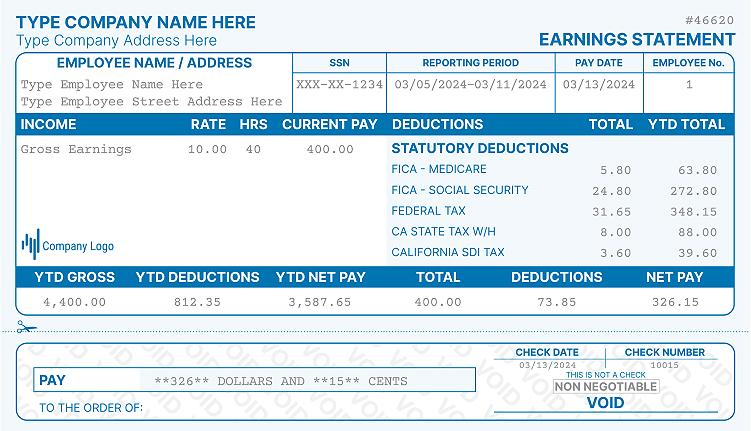
A correct pay stub is easy to recognize once you know which fields to check. Here is what a legitimate stub includes, by pay type, with the key fields to confirm. The same checks double as a guide for spotting a fake.
- Hourly stub: check the hourly rate times hours, any overtime line, gross pay, itemized statutory taxes, and running YTD totals.
- Salary stub: check the per-period salary, pre-tax and post-tax deductions, net pay, and YTD.
- Commission stub: check base pay plus commission as separate earnings lines that roll into gross pay.
- Direct deposit stub: check that net pay matches the deposit and the pay period dates line up.
- Self-employed stub: check earnings against your own records, since there is no employer withholding.
How to spot a fake pay stub. Common tells:
- Round numbers on taxes and earnings. Real withholding rarely lands on clean, even figures.
- Sloppy or inconsistent layout, mismatched fonts, or uneven spacing (often a sign of a hand-edited PDF).
- Incorrect names or values that do not match other records.
A legitimate stub, by contrast, shows itemized statutory taxes, an employer EIN, and running YTD totals that add up period over period.
Editing in Common Tools (ADP, QuickBooks, Gusto)
The honest answer for every major payroll platform is the same: correct the payroll data and reissue the stub, rather than hand-editing a finished document.
- ADP: make the correction in payroll, then reissue the pay statement from the corrected run rather than editing the PDF.
- QuickBooks: fix the paycheck detail in the Payroll section and regenerate the pay stub so totals and YTD recalculate.
- Gusto: correct the payroll entry and reissue; do not edit the downloaded stub by hand.
In each case the goal is a clean, recalculated stub that matches the corrected payroll record.
Reasons You May Need to Edit a Pay Stub
Most edits come down to a handful of legitimate reasons:
- To update employee information: an address change, a new phone number, or a surname change after marriage.
- To correct a pay rate: the employee received a raise or a promotion and the stub still shows the old rate.
- To fix a deduction: a benefit or withholding amount was entered incorrectly.
- To fix minor mistakes: a misspelled name or a missed figure in total pay.
- To comply with state recordkeeping rules: there is no federal law requiring pay stubs, but the Fair Labor Standards Act requires employers to keep accurate records of hours worked and wages paid, and most states also require employers to provide a pay stub or written wage statement. (Source: U.S. Department of Labor, FLSA recordkeeping requirements.)
- To maintain accurate records for former employees: keeping historical stubs correct after someone leaves.
Every one of these is a correction. None of them involves changing what an employee actually earned.
Edit or Reissue With RealCheckStubs
When you need to fix a stub, the fastest safe route is to rebuild it, not patch it. RealCheckStubs lets you enter the correct figures once and generate a clean, professional stub in minutes, with the taxes and YTD totals recalculated for you.
Here is how to reissue a corrected stub:
- Log in and click "Make Pay Stub."
- Choose your template.
- Enter the correct employee details, rate, hours, and deductions.
- Review every field, including the recalculated taxes and YTD.
- Download the corrected stub for printing or online distribution, and retire the incorrect one.
Because every number recalculates from your corrected inputs, the reissued stub is internally consistent, which is exactly what a lender, landlord, or auditor expects to see.
Regenerate a clean, correctly calculated stub now.
You may also want the free editable pay stub templates or the full pay stub template library if you want to see what a complete, correct stub includes before you start.
Frequently Asked Questions
Is it legal to edit a pay stub? When does editing become fraud?
Correcting a genuine error is legal: you are making the stub match what actually happened on payroll. It becomes fraud when you alter the numbers to show income that was not earned, or create a fake stub, and then present it as real. Fraudulent stubs can carry fines, civil liability, and criminal charges. Under 18 U.S.C. § 1014, knowingly giving false information to a financial institution is a federal crime, and falsified income documents can also trigger state fraud statutes and civil liability.
Can an employee edit their own pay stub?
No. Payroll corrections are the employer's or payroll department's responsibility. If you spot an error, report it to payroll in writing and include your supporting documentation, then ask for a corrected, reissued stub.
How do I fix an error that's already on my W-2?
A pay stub edit alone will not fix a filed W-2. You (or your employer) must file Form W-2c (Corrected Wage and Tax Statement) with the Social Security Administration and issue the employee a corrected copy.
How do I edit a pay stub in ADP, QuickBooks, or Gusto?
In all three, correct the payroll data and reissue the stub rather than hand-editing the PDF. Fix the paycheck detail in the payroll section, let the tool recalculate, and regenerate a clean stub.
Can I hand-edit a pay stub PDF? Why is that risky?
You can, but you should not. Hand-editing a PDF leaves mismatched fonts, spacing, and metadata behind, and those are the exact tells that get a stub flagged as altered. Regenerate the stub from corrected figures instead.
How do I edit an old or past pay stub without messing up the YTD?
Remember that changing earnings on any stub changes the YTD totals and the tax withholding that follow. If you correct a past stub, recheck the YTD and tax lines so the running totals still add up across the year.
How do I spot a fake pay stub?
Watch for round numbers on taxes and earnings (real withholding rarely lands on clean figures), sloppy or inconsistent layout, and information that does not match other records. Legitimate stubs show itemized taxes, an employer EIN, and consistent YTD totals.
How do I make an accurate, professional pay stub?
Start from real figures. Enter the true employee information, actual rates, and correct deductions, and let the generator calculate the taxes and totals. An accurate stub is one that reflects what genuinely happened, and complies with federal and state rules. It is not one that is made to look convincing for income that was not earned.
Make and Reissue Professional Pay Stubs With RealCheckStubs
The safest way to fix a pay stub is to correct the real numbers and regenerate a clean stub, never to doctor a finished PDF. RealCheckStubs recalculates taxes and YTD for you, so a corrected stub comes out consistent and professional the first time.

Kristen Larson is a payroll specialist with over 10 years of experience in the field. She received her Bachelor's degree in Business Administration from the University of Minnesota. Kristen has dedicated her career to helping organizations effectively manage their payroll processes with Real Check Stubs.
Our all Posts