California Paycheck Calculator

How much California actually takes out of your paycheck? Expect federal income tax, state income tax (1% to 12.3%), Social Security, Medicare, and California SDI (1.3% in 2026) to eat up roughly 28% to 36% of gross pay for most workers earning $50,000 to $150,000.
A California paycheck calculator guide lets you estimate your real take-home pay in seconds, then you can create a matching pay stub in a minute.
Around 99.2% of California businesses are small, according to the Small Business Administration. If you run one, knowing what every employee takes home after taxes and deductions is essential for budgeting and compliance.
This guide breaks down every California payroll tax for 2026, walks through a real hourly paycheck example, and shows you how to generate a professional pay stub once you have the numbers.
Registering a Business in California in 7 Steps
Registering a business in California involves a few steps. The exact path depends on the business structure you choose.
1. Choose a Business Structure
- Sole Proprietorship: Simplest structure, but you are personally liable for business debts.
- Partnership: Two or more people share ownership and responsibility.
- Limited Liability Company (LLC): Offers personal liability protection and flexible management.
- Corporation: A separate legal entity owned by shareholders.
2. Choose and Register Your Business Name
- Check name availability with the California Secretary of State (SOS).
- Register your business name with the SOS (if applicable).
- Register a fictitious business name (DBA) with your county clerk (if applicable).
3. Obtain an EIN (Employer Identification Number)
- Apply for an EIN from the IRS. This is required even if you don't have employees.
4. Register Your Business with the SOS (if applicable)
- File the formation documents (Articles of Organization for LLCs, Articles of Incorporation for corporations) with the SOS.
5. Obtain Business Licenses and Permits
- Check with the California Department of Tax and Fee Administration (CDTFA) for required licenses and permits.
- Obtain local business licenses and permits from your city or county.
6. Open a Business Bank Account
- This keeps personal and business finances separate.
7. Other Considerations
- Obtain business insurance.
- Set up accounting and payroll systems.
- Stay current on ongoing requirements like taxes and filings.
California Tax Overview
California has the highest top marginal state income tax rate in the country. The state income tax system is progressive, so higher earners pay higher rates.
That high rate has a real impact on take-home pay. State rates run from 1% to 12.3%, with an extra 1% Mental Health Services Tax on income over $1 million.
Cities in California collect local sales taxes, but there are no local income taxes. So whether you work in Sacramento, San Francisco, or Los Angeles, the state income tax rules are the same.
Taxable Base Wage
This used to be the wage cap for State Disability Insurance (SDI). Before 2024, only income up to $153,164 was subject to SDI withholding.
Senate Bill 951 removed that cap. From 2024 onward, all wages are subject to SDI withholding, no matter how high the earnings.
| Year | California SDI Taxable Wage Cap |
| 2024 onward | No cap (SB 951) |
| 2023 | $153,164 yearly |
| 2022 | $145,600 yearly |
| 2021 | $128,298 yearly |
| 2020 | $122,909 yearly |
SUTA Rates
California's unemployment tax rate (SUI) for 2026 follows Schedule F+. Rates run from 1.5% to 6.2% on the first $7,000 of each employee's wages.
New employers pay a 3.4% rate for the first two to three years. Your exact rate arrives each December on your DE 2088 notice from the EDD.
| Year | California SUI Range | New Employer Rate |
| 2026 | 1.5% to 6.2% | 3.4% |
| 2025 | 1.5% to 6.2% | 3.4% |
| 2024 | 1.5% to 6.2% | 3.4% |
FUTA Rates
The standard FUTA tax is 6% on the first $7,000 each employee earns per year. Most states get a 5.4% credit, which drops the rate to 0.6%. California does not get the full credit.
California has not repaid its federal unemployment loan, so it is in its fourth straight year of a FUTA credit reduction. For tax year 2025 (filed on Form 940 in early 2026), the credit is cut by 1.2%. That raises California's effective FUTA rate to 1.8%, or up to $126 per employee.
| Tax Year | Standard FUTA | California Effective Rate (after credit reduction) |
| 2025 | 6% on first $7,000 | 1.8% (credit reduced by 1.2%), up to $126 per employee |
| 2024 | 6% on first $7,000 | 1.5% (credit reduced by 0.9%) |
| 2023 | 6% on first $7,000 | 1.2% (credit reduced by 0.6%) |
💡 Good to Know: The 2026 credit reduction is not final yet. It depends on whether California still has an outstanding loan balance on November 10, 2026. You report all of this on Form 940 (FUTA tax return). For the latest figures, visit the EDD.
FICA Rates
FICA covers Social Security and Medicare. The rates for 2026 are below.
For Employees and Employers
- Social Security Tax: 6.2% on the first $184,500 of wages (the 2026 wage base).
- Medicare Tax: 1.45% on all wages, with no cap.
Additional Medicare Tax
- 0.9% on wages over $200,000 for single filers, or $250,000 for joint filers.
Important Notes
- Employers and employees split FICA equally, 7.65% each.
- Self-employed individuals pay the full 15.3% (both halves).
| Year | Social Security Wage Base | Combined FICA Rate |
| 2026 | $184,500 | 7.65% |
| 2025 | $176,100 | 7.65% |
| 2024 | $168,600 | 7.65% |
Other Taxes
Your payroll may also include mandatory state programs and voluntary benefits. The two main California state rates for 2026 are below.
- The ETT (Employment Training Tax) rate for 2026 is 0.1% on the first $7,000 per employee. This is paid by employers.
- The SDI withholding rate for 2026 is 1.3%. There is no wage cap, so all wages are subject to SDI. This comes out of the employee's paycheck.
For more detail, see the EDD rates page.
Other Deductions on a Paystub
Beyond taxes, you also track paid time off and benefit deductions. These can include health insurance, retirement contributions, and more. Common examples:
- Retirement Contributions: Money put into a 401(k) or other retirement plan.
- Health Insurance Premiums: The employee's share not covered by the employer.
- Life Insurance Premiums: The employee's portion of life insurance costs.
- Disability Insurance Premiums: Voluntary short-term or long-term coverage.
- Union Dues: Fees paid to a labor union.
- Charitable Contributions: Donations made through payroll deduction.
- Wage Garnishments: Court-ordered deductions for things like child support or unpaid debts.
California Payroll Tax Withholding
Each pay period, you withhold the amount the employee elected on Form W-4 (and the state DE 4), plus any extra they requested. You then send it to the IRS and EDD with your regular tax deposits.
At year end, the total wages and taxes you withheld get reported on each employee's W-2. If you need to produce one, our W-2 form maker can generate it in minutes.
California Hourly Paycheck Calculator
"Paycheck" refers to the money you take home as a wage or salary. To find your net pay, start with gross pay and subtract taxes and deductions. Here is how that looks for an hourly worker.
Scenario: Part-Time Retail Worker in Los Angeles, California
- Employee: Sarah
- Position: Part-time Sales Associate
- Hourly Rate: $16.90 (California minimum wage in 2026)
- Hours Worked per Week: 25 hours
- Filing Status: Single
- Pay Period: Bi-weekly (every two weeks)
Additional Information
- Sarah contributes $50 per pay period to her employer's health insurance plan.
- She contributes $25 per pay period to a 401(k).
- She authorized a $10 charitable donation from each paycheck.
Using the California Hourly Paycheck Calculator
- Hourly Rate: $16.90
- Hours Worked: 50 (25 hours per week over 2 weeks)
- Filing Status: Single
- Pay Frequency: Bi-weekly
- State: California
- Additional Deductions: Health $50, 401(k) $25, Charity $10
The California Payroll Tax Calculator Will Output
| Line Item | Amount |
| Gross Pay | $845.00 |
| Federal Income Tax (estimated) | ~$66.00 |
| Social Security (6.2%) | $52.39 |
| Medicare (1.45%) | $12.25 |
| State Disability Insurance (1.3%) | $10.99 |
| California State Income Tax (estimated) | Low at this income, varies by situation |
| Other Deductions (health, 401k, charity) | $85.00 |
| Net Pay (estimated) | ~$610.00 |
These figures are estimates. Actual withholding depends on the employee's filing details and elections. The pay stub generator runs the exact math for you and produces a clean stub.
California Child Support Calculator
When a parent stops living with their child, they may be responsible for paying child support.
To qualify for child support in California, a child must be under 19 or still in high school. Children with disabilities who need ongoing support may qualify for longer.
California courts use statewide guidelines to set the amount. A child support calculator applies those guidelines to the income figures you enter.
Labor Laws in California
California prohibits employer discrimination and retaliation against protected groups.
Employers must also provide reasonable accommodations for pregnancy, pay employees fairly, allow wage negotiations, grant access to personnel records, and protect employees who report wrongdoing.
Good to know: Free Labor Cost Calculator
California Paystub Generator
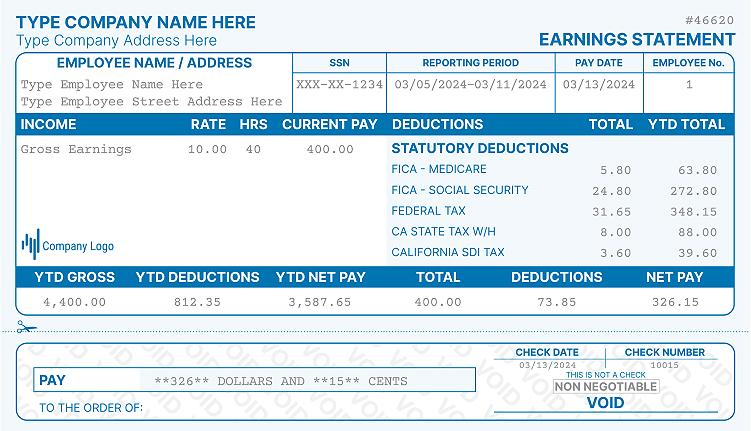
Once you know the numbers, the easiest next step is making the stub itself. Our California pay stub generator calculates taxes and deductions based on current state rules, then produces a professional paystub you can print or download.
It compiles gross pay, subtracts the required withholdings, and shows net pay for each worker.
Real Check Stubs turns what used to take hours into a one-minute task. It also protects you against fraudulent check stub makers.
California Tax Resources
California Department of Tax and Fee Administration
- Website: https://www.cdtfa.ca.gov
- Phone: 1-800-400-7115
- Address: 450 N Street, Sacramento, CA 95814-4311
Other Resources:
- California Employment Development Department (EDD): https://edd.ca.gov/en/payroll_taxes/rates_and_withholding/
- IRS Publication 15 (Circular E): https://www.irs.gov/pub/irs-pdf/p15.pdf
- California Employer's Guide (DE 44): https://edd.ca.gov/siteassets/files/pdf_pub_ctr/de44.pdf
- EDD Tax-Rated Employers: https://edd.ca.gov/en/payroll_taxes/tax-rated-employers/
Frequently Asked Questions
How much does California take out of your paycheck?
For most workers earning $50,000 to $150,000, federal tax, state income tax, FICA, and SDI together take about 28% to 36% of gross pay. The exact share depends on your income, filing status, and deductions.
What does $75,000 a year in California get you after taxes?
A single filer earning $75,000 in California pays roughly $20,000 to $22,000 in total taxes for 2026. That leaves take-home pay of about $4,400 to $4,600 per month, depending on deductions and filing status.
How much do people in California pay in taxes?
If you earn income from a California source, you must file and pay state income tax even if you live elsewhere. Sales tax runs from 7.25% to over 10% by location. State income tax runs from 1% to 12.3%, plus 1% on income over $1 million.
How do I figure out my gross pay?
Take your yearly wage and divide it by the number of pay periods. That gives gross pay for each period. To get take-home pay, subtract payroll taxes and other deductions from gross.

Allen Wood is an accomplished accountant with over 15 years of experience in the field.
Our all Posts