1099 Pay Stub for Independent Contractors: What It Is and How to Create One
- Home
- Blog
- Paystub Generator
- 1099 Pay Stub for Independent Contractors: What It Is and How to Create One

A 1099 pay stub is a self-prepared earnings statement that an independent contractor creates to document client payments for one pay period, with year-to-date totals.
Clients do not issue pay stubs to independent contractors, because contractors are not on payroll and have no tax withheld. The client reports the year's total on Form 1099-NEC instead, once payments reach $2,000 for 2026 payments ($600 for 2025 and earlier).
A 1099 pay stub fills the gap between those annual forms, giving landlords, lenders, and the contractor a period-by-period record of income.
What Is a 1099 Pay Stub?
A 1099 pay stub records the gross payments an independent contractor received during a pay period, the client or project behind each payment, and the running year-to-date total. The name comes from Form 1099-NEC, the IRS information return clients file for nonemployee compensation. A 1099 pay stub is not an IRS form. The contractor prepares the 1099 pay stub from invoices and bank deposits, so every figure on it must match money actually received.
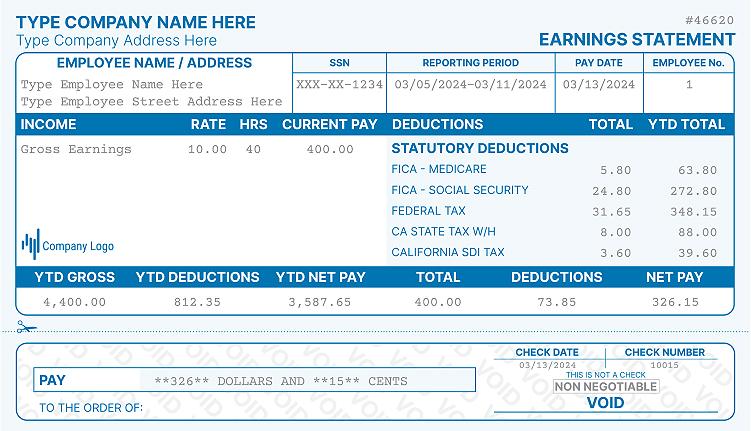
A 1099 pay stub differs from an employee pay stub in one structural way: it shows no withholding. Employees have federal income tax, Social Security, and Medicare withheld by the employer. Independent contractors pay those taxes themselves through quarterly estimated payments, which is why the 1099 pay stub lists gross pay and net pay as the same figure.
Do Independent Contractors Get Pay Stubs?
No, independent contractors do not get pay stubs from the companies that pay them. Pay stubs come from payroll, and independent contractors are paid through invoices, not payroll. No federal law requires pay stubs even for employees, and the state pay stub laws that exist apply to employees, not to independent contractors.
Independent contractors receive three documents from clients instead:
- Payment confirmations, such as a check, ACH deposit, or remittance email for each invoice.
- Form 1099-NEC by January 31 of the following year, if the client paid $2,000 or more in 2026 by check, cash, or direct deposit.
- Form 1099-K from the payment processor, instead of a 1099-NEC, when the client paid by credit card or a third-party network and the platform's $20,000 and 200-transaction threshold is met.
A contractor who needs period-by-period proof of income creates a 1099 pay stub from those records. A contractor who receives a W-2, a pay stub, and withheld taxes from a company is an employee of that company, not an independent contractor, regardless of the job title.
1099 Pay Stub vs. Form 1099-NEC vs. Employee Pay Stub
The three documents differ by who issues them, how often, and what they prove. The following table compares the 1099 pay stub, Form 1099-NEC, and an employee pay stub across 6 attributes.
| Attribute | 1099 pay stub | Form 1099-NEC | Employee pay stub |
|---|---|---|---|
| Prepared by | The contractor | The client (payer) | The employer's payroll |
| Frequency | Each pay period or invoice | Once a year | Each payday |
| Filed with the IRS | No | Yes | No (summarized on Form W-2) |
| Tax withholding shown | None | Backup withholding only, if any | Federal, state, Social Security, Medicare |
| Reporting threshold | None | $2,000 per payee for 2026 payments | None |
| Main use | Proof of income between tax years | Tax reporting | Proof of income and payroll record |
Because the 1099 pay stub is the only one of the three a contractor controls, its accuracy depends entirely on the contractor's records, which the next section breaks down field by field.
What Should a 1099 Pay Stub Include?
A 1099 pay stub includes the contractor's business details, the pay period, each payment received, and year-to-date gross income. The following are the 9 fields a complete 1099 pay stub contains:
- Contractor name or business name, as the issuer of the statement.
- Business address and EIN, or the last four digits of the contractor's SSN.
- Pay period start and end dates.
- Payment date for each payment received.
- Client name and invoice or project number for each payment.
- Hours and hourly rate, or the flat project fee.
- Gross payment for the period.
- Withholding lines set to $0.
- Year-to-date gross income.
Two items stay off a 1099 pay stub. The first is any tax withholding the contractor did not have taken out; a contractor who sets money aside for estimated taxes labels that line "estimated tax set-aside," never "federal withholding." The second is the client's name in the employer or issuer position. The contractor's own business issues the 1099 pay stub, and the client appears only in the payment description, because presenting the stub as a client-issued payroll document misstates the working relationship.
The example below shows a 1099 pay stub for a freelance designer paid on two invoices in one semi-monthly period:
| Field | Example value |
|---|---|
| Issuer | Maria Lopez Design LLC, EIN 12-3456789 |
| Pay period | October 1, 2026 to October 15, 2026 |
| Payment 1 | October 6, Brightline Media, invoice 1042, 18 hours at $85 = $1,530.00 |
| Payment 2 | October 14, Harbor Dental, invoice 1045, flat fee = $1,200.00 |
| Gross pay this period | $2,730.00 |
| Federal, state, Social Security, Medicare withheld | $0.00 |
| Net pay this period | $2,730.00 |
| Year-to-date gross | $51,840.00 |
Every line in this example traces back to an invoice and a deposit, and that traceability is what the creation steps below are built around.
How to Create a 1099 Pay Stub

To create a 1099 pay stub, gather the period's invoices and deposits, enter them into a pay stub generator with withholding set to zero, and check the year-to-date total against your records. The following are the 6 steps to create an accurate 1099 pay stub:
- Gather records. Collect every invoice paid during the pay period and the matching bank deposit or payment confirmation.
- Choose a pay period. Use the period the landlord or lender asks for, typically weekly, biweekly, semi-monthly, or monthly, and keep it consistent across stubs.
- Open a template. Select a layout in the Real Check Stubs pay stub generator and enter your business as the issuer.
- Enter payments. Add each payment with its date, client, invoice number, and amount, and set federal, state, Social Security, and Medicare withholding to $0.
- Verify year-to-date income. Confirm the year-to-date figure equals the sum of all payments received since January 1, as shown in your bank statements.
- Download and file. Save the PDF with the invoices it covers, so the 1099 pay stub and its source documents stay together.
Real Check Stubs stores each order, so a contractor can request another copy of a 1099 pay stub with the email address used at checkout.
Who Accepts a 1099 Pay Stub as Proof of Income?
Landlords, car lenders, and personal loan lenders accept a 1099 pay stub as supporting proof of income, and mortgage lenders treat it as a supplement to tax returns rather than a replacement. Self-employment income is verified differently from salary, because no employer confirms it. The following are the 4 documents that verifiers pair with a 1099 pay stub:
- Forms 1099-NEC or 1099-K from the prior tax year.
- Federal tax returns with Schedule C for the most recent one to two years.
- Bank statements showing the deposits listed on the 1099 pay stub.
- A year-to-date profit and loss statement for the contractor's business.
A 1099 pay stub that matches those documents line for line strengthens an application. A 1099 pay stub that overstates income, invents a client, or lists withholding that never happened is a false statement to the lender or landlord and exposes the contractor to fraud liability. The guide to showing proof of income without pay stubs covers the alternatives in detail.
How Taxes Work Without Withholding on a 1099 Pay Stub
Independent contractors pay income tax plus 15.3% self-employment tax on net earnings, through quarterly estimated payments instead of paycheck withholding. The self-employment tax rate combines 12.4% for Social Security and 2.9% for Medicare, applied to 92.35% of net self-employment earnings and reported on Schedule SE.
A contractor with $40,000 in net profit owes self-employment tax on $36,940 ($40,000 × 92.35%), which equals $5,651.82 before income tax. The four 2026-2027 estimated tax due dates are April 15, June 15, and September 15, 2026, and January 15, 2027.
The higher 1099-NEC threshold changes paperwork, not tax. A client who paid a contractor $1,800 in 2026 is not required to send a 1099-NEC, yet that $1,800 remains taxable income the contractor reports on Schedule C. Year-to-date totals on 1099 pay stubs make that income easy to reconcile at filing time. The full process is in the guide to independent contractor tax filing.
Paying Contractors? How Businesses Issue Form 1099-NEC
A business that pays an independent contractor $2,000 or more in 2026 issues Form 1099-NEC to the contractor and files it with the IRS by February 1, 2027. The usual January 31 deadline falls on a Sunday in 2027, so the due date moves to the next business day. For 2026 payments, Form 1099-NEC reports nonemployee compensation in Box 1a, which replaced the single Box 1 used for earlier years.
The business collects Form W-9 from the contractor before the first payment, then enters the payer details, the contractor's taxpayer identification number, and the year's total in Box 1a. The filing rules are explained in what Form 1099-NEC is and who needs to file it.
Payments that are not for services, such as office rent, royalties, prizes, and awards, go on Form 1099-MISC instead of Form 1099-NEC. The Real Check Stubs Form 1099 generator creates Form 1099-MISC online and produces a downloadable PDF.
Frequently Asked Questions
Is it legal to make your own 1099 pay stub?
Yes, making your own 1099 pay stub is legal when every figure reflects payments you actually received. Inflating income, inventing clients, or showing fake withholding on a 1099 pay stub submitted to a lender or landlord is fraud.
Can a contractor create their own Form 1099?
No, a contractor cannot issue a Form 1099-NEC to themselves. The business that paid the contractor issues and files Form 1099-NEC. A contractor who did not receive one reports the income from invoices and bank records instead.
What if I did not receive a 1099-NEC?
Report the income anyway, using your own invoices and deposits. Clients do not issue 1099-NEC forms for 2026 payments under $2,000, and income is taxable whether or not a 1099 arrives. Ask the client for a missing form by mid-February.
Do 1099 pay stubs show taxes taken out?
No, 1099 pay stubs show $0 in tax withholding, because clients do not withhold taxes from independent contractors. Gross pay and net pay are the same figure. Contractors pay income and self-employment tax through quarterly estimated payments.
How many 1099 pay stubs do I need for an apartment?
Landlords typically request the two to three most recent months of income records. For a 1099 contractor, that means two to three months of 1099 pay stubs plus the matching bank statements or the prior year's 1099 forms.
Is a 1099 pay stub the same as a 1099 form?
No, a 1099 pay stub is a contractor-prepared earnings statement for one pay period, while Form 1099-NEC is an annual IRS information return the paying business files. The 1099 pay stub is never filed with the IRS.
Why is it important for a 1099 contractor to review their pay stub?
Reviewing a 1099 pay stub catches missed or short client payments and keeps the year-to-date total accurate. That total sizes quarterly estimated tax payments and should match the 1099-NEC forms received at year end.
Can a 1099 contractor get a pay stub from the client?
No, clients do not issue pay stubs to independent contractors because contractors are paid outside payroll. A client provides payment confirmations and, at year end, Form 1099-NEC, which the contractor uses to build accurate 1099 pay stubs.

Kristen Larson is a payroll specialist with over 10 years of experience in the field. She received her Bachelor's degree in Business Administration from the University of Minnesota. Kristen has dedicated her career to helping organizations effectively manage their payroll processes with Real Check Stubs.