
California Paystub Generator
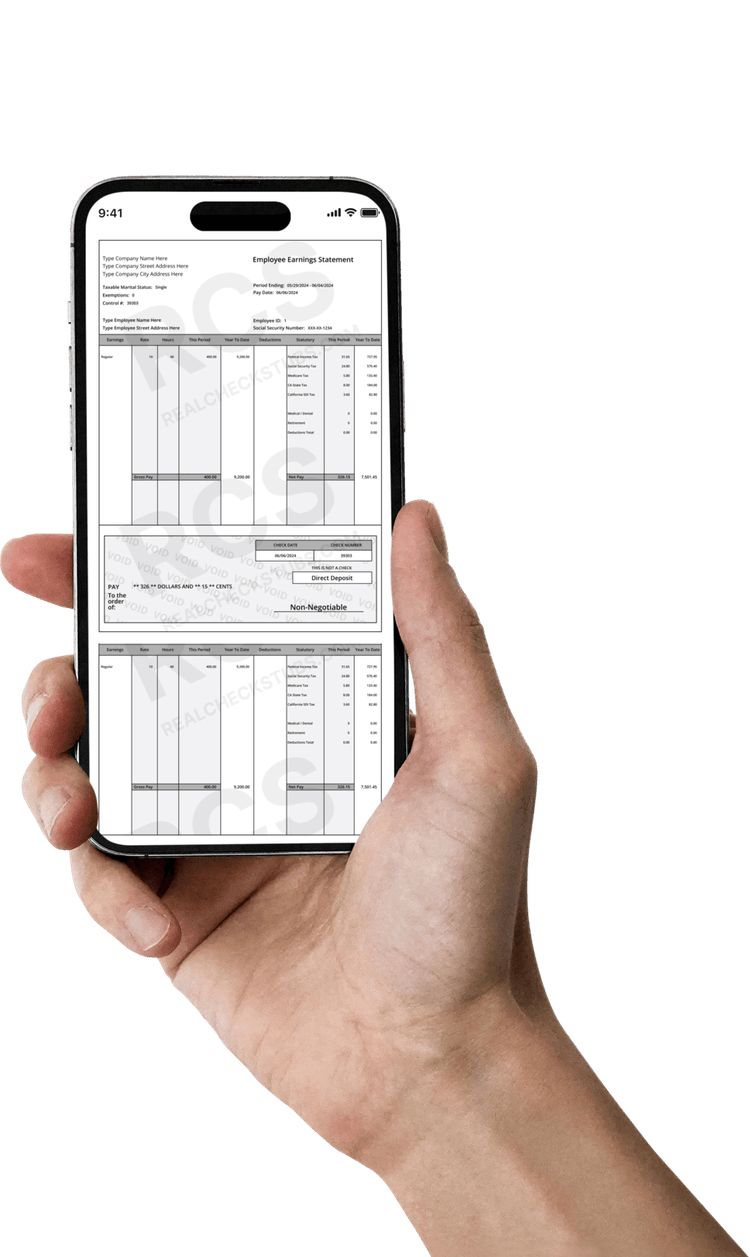
California has the most demanding payroll rules in the country, and that shows up on every pay stub. The state runs nine income tax brackets, a mandatory SDI deduction with no wage cap, and Labor Code 226 lists exactly what your wage statement must contain. Whether you're a freelancer in Los Angeles, a gig worker in the Bay Area, or a small business running payroll, our generator builds a Section 226–compliant stub with accurate state income tax, CASDI, and federal withholding — delivered as a professional PDF in under two minutes.
💰 Money-back guarantee ⚡ Instant delivery
Estimate Your California Take-Home Pay
See exactly what you'll take home at 2026 rates: federal tax, Social Security, Medicare, and California's cut, itemized per paycheck.
| Line | Per paycheck | Per year |
|---|
Want the math for a different state? Try the full paycheck calculator for all 50 states.
Estimate only. Actual withholdings depend on your W-4 elections, employer benefits, and local deductions. This tool does not constitute tax advice.
California Payroll Tax Overview
State Income Tax
California uses a progressive income tax with nine brackets running from 1% to 12.3%. A 1% Behavioral Health Services Tax (formerly the Mental Health Services Tax) applies to taxable income above $1,000,000, which pushes the top marginal rate to 13.3% — the highest of any state.
Only the income inside each band is taxed at that band's rate, so your effective rate sits well below the headline number. A single filer with $100,000 of taxable income pays roughly $5,800 in state tax for 2026, an effective rate under 6%. The Franchise Tax Board indexes the bracket thresholds to inflation each year, so the dollar figures shift slightly even though the rates stay the same.
California's standard deduction is much smaller than the federal one. For 2026 the FTB set it at $5,706 for single and married-filing-separately filers, and $11,412 for married filing jointly, head of household, and qualifying surviving spouse. That gap is why many Californians owe more state tax than a federal-only estimate would suggest.
Supplemental pay has its own flat withholding rates. Bonuses and stock options are withheld at 10.23%, and other supplemental wages at 6.6%. If your bonus looked heavily taxed, that 10.23% state rate stacked on top of federal supplemental withholding is usually why.
State-Specific Mandatory Deductions
The one state payroll deduction that comes out of your wages is State Disability Insurance (SDI). For 2026 the SDI rate is 1.3%, up from 1.2% in 2025, and there is no wage cap. Since January 1, 2024, under Senate Bill 951, every dollar you earn in California is subject to SDI, so high earners now contribute on their full salary.
SDI funds two programs: short-term Disability Insurance and Paid Family Leave (PFL). There is no separate PFL line on your stub because PFL is paid from the same 1.3% contribution. The same withholding shows up labeled CASDI, SDI, or VPDI (if your employer runs an EDD-approved voluntary plan). The maximum weekly DI/PFL benefit rose to $1,765 for 2026.
California's other state payroll taxes — Unemployment Insurance and the 0.1% Employment Training Tax — are paid entirely by the employer. They never appear as employee deductions, so a worker's stub should show SDI as the only state-level withholding besides income tax.
Local Tax Considerations
This is where California is simpler than states like Ohio or Pennsylvania: California has no local or city income tax withheld from employee paychecks. San Francisco, Los Angeles, and other cities levy business taxes such as gross receipts and employer payroll expense taxes, but those fall on the employer and do not reduce an employee's take-home pay. You will not see a city income tax line on a California stub.
California Paystub Requirements
Mandatory Delivery
California is not an access state. Under Labor Code Section 226, employers must give every employee an accurate, itemized wage statement each pay period, and wages must be paid at least twice a month on predesignated paydays. The stub can be paper or electronic, as long as the worker can easily access it and print a hard copy.
Required Information
A compliant California wage statement must show nine specific items: gross wages earned, total hours worked (for non-exempt employees), the number of piece-rate units and the piece rate if applicable, all deductions, net wages, the inclusive dates of the pay period, the employee's name with the last four digits of their Social Security number or an employee ID, the employer's legal name and address, and all applicable hourly rates with the hours worked at each rate.
California adds a requirement most states do not have: available paid sick leave must appear on the wage statement or in a separate document given on the same day. A generic stub that omits sick leave balances or the hourly-rate breakdown can fall short of Section 226.
Penalties are real. Employees can recover $50 for an initial violation and $100 for each later one, up to $4,000, plus attorney's fees, and wage statement defects are a frequent basis for PAGA lawsuits. That is why accuracy matters when you create a California pay stub for your own records or your team.
Record Retention
Employers must keep copies of itemized wage statements for at least three years, at the place of employment or a central California location. Workers can request to inspect or copy their payroll records, and the employer has 21 days to comply. Many California employment attorneys suggest keeping records four years to cover the longer statute of limitations under the Unfair Competition Law.
Special Situations in California
Tipped Workers
California does not allow a tip credit. Tipped employees must be paid the full state minimum wage of $16.90 per hour in 2026 before tips, not a lower tipped rate. Tips belong to the employee and cannot be counted toward the employer's minimum wage obligation, so a California server's base hourly rate on the stub should never dip below minimum wage.
Minimum Wage and Industry Rates
The 2026 statewide minimum wage is $16.90 for employers of all sizes. Fast food workers at chains with 60 or more national locations earn at least $20.00 per hour, and covered health care facility workers earn between $18.63 and $25.00 depending on facility type, with another scheduled bump on July 1, 2026. More than 40 cities and counties set local minimums above the state floor, and the rate that applies is based on where the employee physically works.
The exempt salary threshold tracks the state minimum wage at twice full-time pay, which is $70,304 per year for 2026. Exempt computer software professionals have a separate floor of $58.85 per hour or $122,573.13 annually.
Agriculture and Entertainment
Farm workers in California now earn overtime under the AB 1066 phase-in, after 8 hours a day or 40 a week for most employers — a stricter standard than federal law. Entertainment industry pay brings its own wrinkles: loan-out corporations, residuals, and multi-state shoots that complicate withholding. In both cases the stub needs to reflect the correct overtime hours and rates to stay Section 226 compliant.
When You Need a California Paystub
California's housing costs make proof of income a constant requirement. Landlords in Los Angeles, San Francisco, San Diego, and San Jose routinely ask for recent pay stubs, and many high-rent markets expect applicants to show income of two to three times the monthly rent. Several rent-controlled and affordable-housing programs in the state also verify income through pay stubs.
Self-employed and gig workers — a huge share of California's workforce — often have no employer-issued stub when applying for an auto loan, a mortgage, or a state program. Generating clean, itemized stubs that show year-to-date earnings and California deductions is the simplest way to document income. Our paystub generator produces Section 226–style documentation that includes the CASDI line, state income tax, and all required fields.
EDD claims for SDI or Paid Family Leave also go more smoothly when your wage history is clearly documented. Having organized paystubs on hand speeds up the verification process and reduces back-and-forth with the Employment Development Department.
California W-2 Requirements and Reporting
Your pay stubs and your year-end W-2 should tell the same story. The year-to-date totals on your final 2026 pay stub — gross wages, state income tax withheld, and SDI — should match the figures reported on your W-2. If they do not line up, that is your signal to investigate before filing.
State Tax Reporting on California W-2s
On a California W-2:
- Box 15 shows "CA" and the employer's California state ID number.
- Box 16 reports state wages, which for most workers equals federal wages, though differences can appear with items like certain retirement contributions.
- Box 17 shows California income tax withheld. This should align with your year-to-date state tax total from your final paystub.
- Box 14 is where CASDI (SDI) usually appears, since it is a state-mandated employee contribution rather than a regular tax. That Box 14 SDI amount matters at tax time: if you worked for more than one employer and they collectively over-withheld SDI, you can claim the excess as a credit on your California return.
- Boxes 18–20 (local wages and taxes) are normally blank for in-state California work, as California has no local income tax.
Multi-State Workers
Multi-state situations need extra care. California taxes residents on all income and taxes nonresidents on California-source income, and the state does not have reciprocity agreements with neighboring states. If you live in California but work remotely for an out-of-state employer, or commute across a state line, your W-2 state boxes should reflect where the work was performed.
Generate Your California W-2 Form
Need to produce year-end forms? Our California W-2 Generator fills the state boxes correctly — including the CA Box 15/16/17 fields and Box 14 CASDI — so your W-2 stays consistent with the stubs you issued during the year. You can generate a W-2 for California in a few minutes.
Ready to generate your California paystub?
Create a Section 226–compliant, professional paystub in under 2 minutes.
No accounting knowledge needed.
California Paystub Questions
Does California require employers to provide pay stubs?
Yes. Labor Code Section 226 requires an accurate, itemized wage statement every pay period, and wages must be paid at least twice a month. California is not an access state, so the statement has to be furnished, not just made available on request.
What percentage of my California paycheck goes to SDI in 2026?
1.3% of your wages, with no wage cap, up from 1.2% in 2025. That single deduction funds both State Disability Insurance and Paid Family Leave, which is why there is no separate PFL line on your stub.
What is the minimum wage for tipped workers in California in 2026?
It is the full $16.90 per hour, the same as for non-tipped workers. California prohibits a tip credit, so tips cannot be applied toward an employer's minimum wage obligation.
Are there local income taxes withheld from California paychecks?
No. California cities and counties do not levy an employee income tax, so your stub should not show a city or county income tax line. Local taxes like San Francisco's payroll expense tax are paid by employers, not deducted from workers.
How long must California employers keep payroll records?
At least three years, at the worksite or a central California location. Employees can request to inspect or copy their records, and the employer must respond within 21 days.
What is the new law for salaried employees in California for 2026?
The exempt salary threshold rose to $70,304 per year as the state minimum wage increased to $16.90 per hour, since the exempt minimum is set at twice full-time minimum wage. Employees earning below that generally cannot be classified as exempt from overtime.
How are bonuses taxed in California in 2026?
California withholds a flat 10.23% on bonuses and stock options, and 6.6% on other supplemental wages, separate from federal supplemental withholding. This is withholding, not your final tax, so the actual amount owed is settled when you file.
Can my California employer give me an electronic pay stub instead of paper?
Yes, as long as you can easily access the statement and print a paper copy. The electronic version still has to contain all nine items required by Labor Code Section 226.
References
- California Employment Development Department (EDD) — Payroll Tax Rates and Withholding
- California EDD — Tax-Rated Employers (SDI, UI, ETT rates)
- California Department of Industrial Relations — Minimum Wage
- California DIR — General Minimum Wage Order MW-2026
- California DIR/DLSE — Paydays, Pay Periods, and Final Wages
- California Labor Code Section 226 — Itemized Wage Statements
- California Franchise Tax Board — Tax Rates and Brackets