
Colorado Paystub Generator
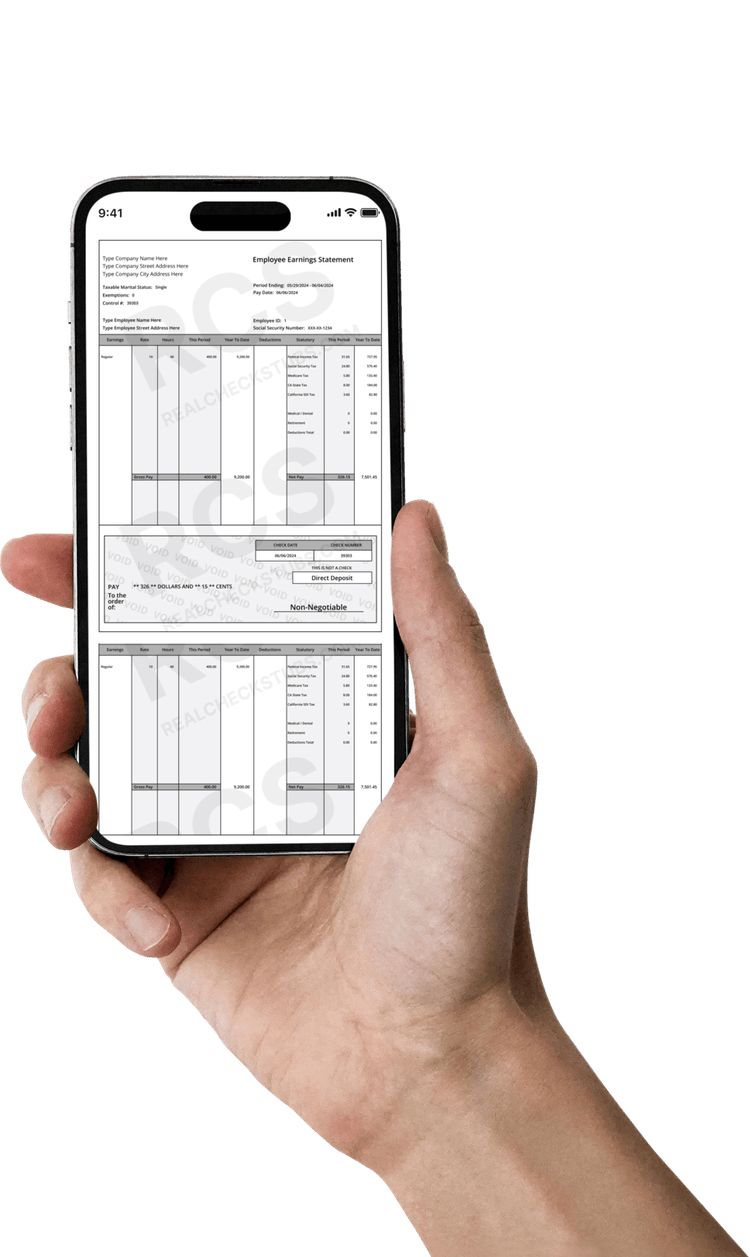
Colorado runs a flat 4.40% income tax with no brackets, but your check can still carry a FAMLI premium, a Denver-area Occupational Privilege Tax, and a paid sick leave balance some employers print right on the stub. Whether you work in Denver, Colorado Springs, Boulder, or a mountain town, our generator builds a clean, itemized Colorado pay stub with all the state-specific lines — professional PDF in under two minutes.
💰 Money-back guarantee ⚡ Instant delivery
Estimate Your Colorado Take-Home Pay
See exactly what you'll take home at 2026 rates: federal tax, Social Security, Medicare, and Colorado's cut, itemized per paycheck.
| Line | Per paycheck | Per year |
|---|
Want the math for a different state? Try the full paycheck calculator for all 50 states.
Estimate only. Actual withholdings depend on your W-4 elections, employer benefits, and local deductions. This tool does not constitute tax advice.
Colorado Payroll Tax Overview
State Income Tax: Flat 4.40%
Colorado taxes income at a single flat rate of 4.40% for 2026. There are no tax brackets, and the same rate applies whether you earn $30,000 or $300,000. The Colorado Constitution requires this flat structure, so the rate cannot become graduated without a statewide vote.
You may remember a lower number on recent returns. For tax year 2024 the rate was temporarily cut to 4.25% under the Taxpayer's Bill of Rights (TABOR) surplus mechanism. That surplus has since collapsed, so the permanent 4.40% rate is back in effect for 2025 and 2026 withholding.
Colorado does not have a local income tax. Cities here cannot tax your wages by percentage. What some Denver-metro cities do charge is a flat per-month Occupational Privilege Tax, which is a different thing from an income tax and is covered below.
FAMLI: Colorado's Paid Family Leave Deduction
Colorado's Family and Medical Leave Insurance (FAMLI) program is funded by a payroll premium that appears on most pay stubs. For 2026 the total premium is 0.88% of gross wages, down from 0.90%. Employees pay half, so the most that can be withheld from your check is 0.44%.
Employers with 10 or more workers pay the other 0.44%. Employers with nine or fewer employees owe no employer share, but they still withhold the 0.44% employee portion. The premium only applies to wages up to the Social Security cap, which is $184,500 for 2026. The maximum weekly FAMLI benefit in 2026 is $1,381.45.
A 2025 law, Senate Bill 25-144, both reduced the premium to 0.88% and added up to 12 extra weeks of leave for parents whose newborn needs neonatal intensive care.
Local Occupational Privilege Tax (OPT)
A handful of Denver-area cities charge an Occupational Privilege Tax, often called a "head tax." It is a flat dollar amount per month, not a percentage, and it is tied to where you physically perform the work rather than where you live. Aurora eliminated its OPT effective January 1, 2025, so it no longer applies there.
| City | Employee share / month | Monthly earnings threshold |
|---|---|---|
| Denver | $5.75 | More than $499 |
| Glendale | $5.00 | More than $750 |
| Greenwood Village | $2.00 | $250 or more |
| Sheridan | $3.00 | No threshold |
If you work from home outside these city limits, you generally do not owe the OPT for those remote days. Workers in Colorado Springs, Fort Collins, Boulder, and Pueblo pay no OPT at all.
Minimum Wage in Colorado
The statewide minimum wage rose to $15.16 per hour in 2026, the first time it has crossed $15. The tipped minimum is $12.14 per hour, with a tip credit of up to $3.02. Several cities set higher local floors, including Denver at $19.29 ($16.27 tipped) and Edgewater at $18.17. Boulder sets its own city rate as well.
Recent Legislative Changes (2025 to 2026)
Two updates matter for what shows up on a 2026 Colorado stub. COMPS Order #40 took effect February 1, 2026, expanding employer recordkeeping for vacation and sick leave hours. Separately, House Bill 25-1001 raised the state's wage-claim jurisdiction from $7,500 to $13,000 per employee starting July 1, 2026, which raises the stakes for inaccurate or missing pay records.
Colorado Paystub Requirements
Are Pay Stubs Mandatory?
Yes. Under the Colorado Wage Act, every employer must give each employee an itemized written pay statement at least monthly or at the time of each wage payment. Electronic stubs are allowed, as long as the employee can securely view and print the record.
What Must Appear on the Stub
Colorado law requires six specific items on each pay statement:
- Gross wages earned for that pay period
- All withholdings and deductions
- Net wages earned
- The inclusive dates of the pay period
- The employee's name or Social Security number
- The name and address of the employer
Many Colorado employers also print the Healthy Families and Workplaces Act (HFWA) sick leave balance on the stub. That is one of the permitted ways to disclose accrued, used, and available sick hours. The law requires employers to provide that balance on request (up to once a month), and a pay stub line is a common way to satisfy it.
Pay Timing and Record Retention
Pay periods cannot run longer than one calendar month, and wages are due within 10 days after the pay period closes. Employers must keep records of the information on each itemized pay statement for at least three years after wages were due. Sick leave accrual and usage records must be kept for two years. Failing to produce pay statement records can cost an employer $250 per employee per month, up to $7,500.
Special Situations in Colorado
Tipped Workers
A worker counts as tipped in Colorado once they regularly earn more than $30 a month in tips. Employers may apply a tip credit of up to $3.02 per hour, paying a cash wage of $12.14 statewide, as long as tips bring total pay to at least $15.16. In Denver the tipped cash wage is higher at $16.27, and tips must reach the city's $19.29 floor. If an employer deducts credit card processing fees from tips, it loses the right to pay the tipped minimum.
Public-Sector and PERA Employees
Most Colorado state and local government workers contribute to the Public Employees' Retirement Association (PERA) instead of Social Security. On a PERA member's stub you will usually see a PERA contribution line and often no Social Security (OASDI) withholding. State employees also see the FAMLI premium deducted, since the state participates in the program.
Cannabis, Tourism, and Aerospace Payrolls
Colorado's legal cannabis industry runs largely in cash because of federal banking limits, which makes clean, itemized pay records especially important for dispensary and grow-operation workers. The mountain resort and tourism economy leans on seasonal staff whose hours and tips swing through the year, so a stub that itemizes each pay period helps with income verification. The Front Range aerospace and tech employers tend to run standard payroll, but their stubs still carry the FAMLI line and, for Denver offices, the OPT.
When You Need a Colorado Paystub
Housing costs drive a lot of paystub requests here. Front Range landlords in Denver and Boulder, and property managers in resort towns like Vail and Breckenridge, routinely ask for recent stubs proving income two to three times the rent. Mortgage and auto lenders in a competitive Colorado market want the same proof of take-home pay.
Stubs also help with state programs. To qualify for FAMLI benefits, you need to have earned at least $2,500 in Colorado wages over the prior year, and your stubs document that. Self-employed Coloradans, including cannabis-sector and gig workers who do not get a traditional check, often create a pay stub to show consistent income when a W-2 is not available.
Colorado W-2 Requirements and Reporting
Your pay stubs and your year-end W-2 should tell the same story. The year-to-date totals on your final 2026 stub for gross wages, Colorado tax withheld, and FAMLI premiums should match the figures on your W-2. If they do not line up, that is a signal to ask your employer before you file.
State and Local Boxes on a Colorado W-2
- Box 15 lists "CO" and the employer's Colorado withholding account number.
- Box 16 shows Colorado state wages, which usually mirror your federal wages since the state starts from federal taxable income.
- Box 17 reports Colorado income tax withheld, calculated at the flat 4.40% rate.
- Boxes 18–20 are for local income tax. Because Colorado's Occupational Privilege Tax is a flat occupational charge and not an income tax, it generally does not appear in these boxes.
- Box 14 is where your FAMLI premium typically appears, labeled as "FAMLI" or "Other." It is not taxable for Colorado income tax purposes.
Multi-State Work and Corrections
Colorado withholding is set using Form DR 0004, the state withholding certificate, alongside the federal W-4. If you live in Colorado but work in another state, or the reverse, your wages may be split across more than one state's boxes, so check that the Colorado portion is right. If your W-2 is wrong you can request a W-2c from your employer, and a final pay stub can be used to file a Substitute Colorado W-2 (Form DR 0084) if needed.
Generate Your Colorado W-2 Form
Need to produce a W-2 for Colorado employees? Our Colorado W-2 Generator fills in the state wage and withholding boxes and FAMLI reporting, so the form matches your payroll records.
Ready to generate your Colorado paystub?
Flat 4.40% state tax, FAMLI premium, and Denver OPT — all calculated and itemized automatically.
No accounting knowledge needed.
Colorado Paystub Questions
Does Colorado require employers to provide pay stubs?
Yes. The Colorado Wage Act requires an itemized written pay statement at least monthly or with each payment of wages. Electronic stubs are fine as long as you can view and print them securely.
What are the payday requirements in Colorado?
Pay periods cannot exceed one calendar month, and wages must be paid within 10 days after the pay period ends. Employers can pay more often, such as weekly or biweekly, as long as the schedule stays consistent.
How does Colorado's flat tax affect my paycheck?
Colorado withholds state income tax at a flat 4.40% of taxable wages, with no brackets, so the rate is the same regardless of how much you earn. There is no local percentage income tax to add on top.
What is the FAMLI deduction on my Colorado paycheck?
FAMLI is Colorado's paid family and medical leave premium. For 2026 your share is 0.44% of gross wages, up to the $184,500 wage cap, and it usually appears as a separate FAMLI line on your stub. Employers with nine or fewer staff still withhold this employee share.
Do I pay a local tax on my Denver paycheck?
If you work in Denver and earn more than $499 in a month, $5.75 is withheld for the Occupational Privilege Tax. It is a flat monthly amount, not a percentage, and Glendale, Greenwood Village, and Sheridan have their own versions. Aurora dropped its OPT in 2025.
What is the minimum wage for tipped workers in Colorado?
The statewide tipped cash wage is $12.14 per hour in 2026, with tips required to bring total pay to at least $15.16. In Denver the tipped wage is $16.27, and tips must reach the city floor of $19.29.
How long must Colorado employers keep payroll records?
Employers must retain the information on each itemized pay statement for at least three years after the wages were due. Sick leave accrual and usage records must be kept for two years. Missing pay records can trigger fines of $250 per employee per month.
What is the TABOR surplus and how did it affect my Colorado tax?
Colorado's Taxpayer's Bill of Rights (TABOR) allows temporary income tax rate cuts when the state runs a budget surplus. For tax year 2024 the rate was cut to 4.25%. That surplus has since collapsed, so the permanent 4.40% rate is back in effect for 2025 and 2026.
References
- Colorado Department of Revenue — Individual Income Tax
- Colorado Department of Revenue — TABOR Refund
- Colorado FAMLI Division — For Employers
- Colorado Department of Labor and Employment — Paydays, Pay Periods, and Pay Statements
- Colorado Department of Labor and Employment — Wage and Hour Laws (including Paid Sick Leave)
- Colorado Wage Act, C.R.S. 8-4-103
- City and County of Denver — Local Minimum Wage
- Colorado Department of Revenue — Wage Withholding, W-2 & 1099 Statements