
Florida Paystub Generator
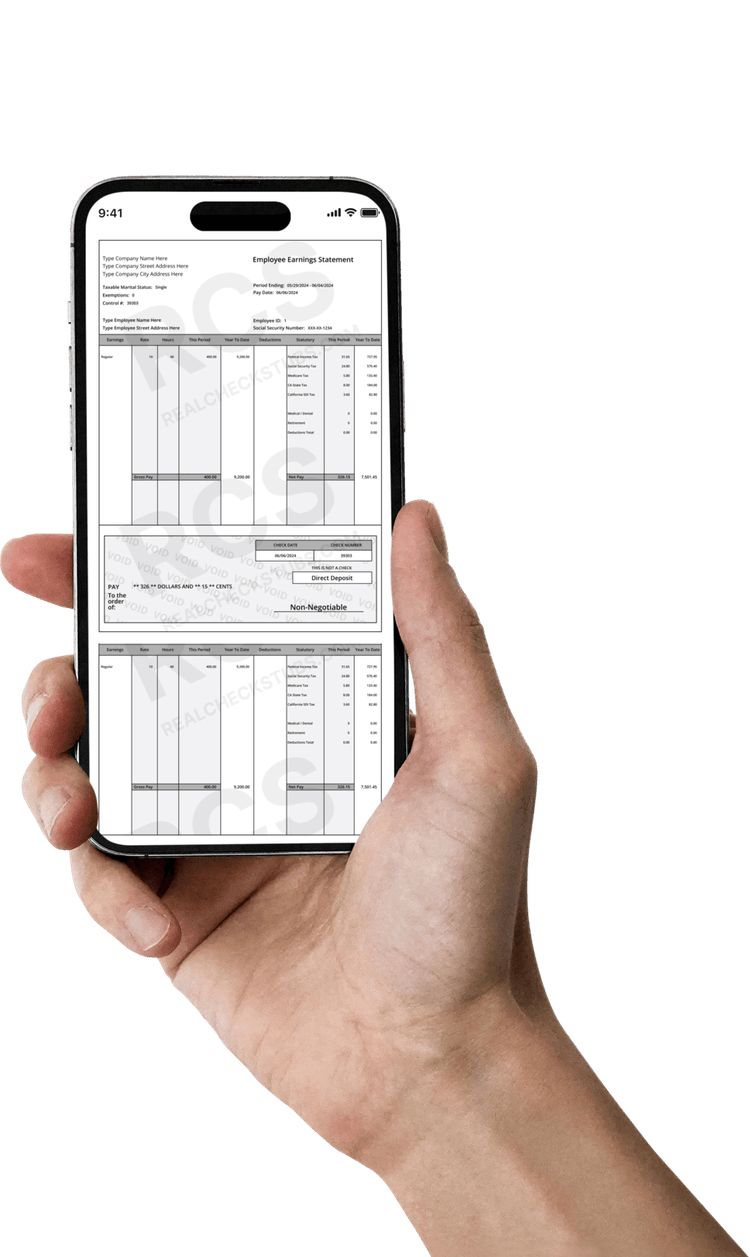
Florida is one of the few states with no state income tax, which changes what a paycheck looks like here. There is no state withholding line, no local income tax, and no state disability deduction to account for. Whether you run a restaurant in Miami, a contracting crew in Tampa, or freelance in Orlando, our paystub generator builds clean, correct stubs for hourly, salaried, and tipped workers — delivered as a professional PDF in under two minutes.
💰 Money-back guarantee ⚡ Instant delivery
Estimate Your Florida Take-Home Pay
See exactly what you'll take home at 2026 rates: federal tax, Social Security, Medicare, and Florida's cut, itemized per paycheck.
| Line | Per paycheck | Per year |
|---|
Want the math for a different state? Try the full paycheck calculator for all 50 states.
Estimate only. Actual withholdings depend on your W-4 elections, employer benefits, and local deductions. This tool does not constitute tax advice.
Florida Payroll Tax Overview
No State Income Tax
Florida does not tax personal income. The state constitution prohibits it, so there is no state income tax withholding on any Florida paycheck. This is the single biggest thing that sets a Florida pay stub apart. On a stub from California or New York you would see a state tax line; on a Florida stub, that line does not exist.
For workers, the practical effect is a larger share of gross pay landing in take-home pay. The only mandatory withholdings on a standard Florida paycheck are the federal ones: federal income tax, Social Security at 6.2% on wages up to $176,100, and Medicare at 1.45% on all wages. For higher earners, the Additional Medicare Tax of 0.9% applies to wages above $200,000 for single filers or $250,000 for married filers.
Florida is one of nine states with no income tax, alongside Alaska, Nevada, New Hampshire, South Dakota, Tennessee, Texas, Washington, and Wyoming. Workers who relocate to Florida from high-tax states like California or New York often notice the difference immediately in their first Florida paycheck.
Reemployment Tax (Florida's Unemployment Tax)
Florida funds unemployment benefits through Reemployment Tax, the state's name for unemployment insurance. This is paid entirely by the employer. Florida law does not allow employers to deduct Reemployment Tax from employee wages, so it never appears as a deduction on a worker's stub.
The tax applies only to the first $7,000 of each employee's wages per year. New employers pay 2.7%. After about 10 quarters, the Florida Department of Revenue assigns an experience rate that ranges from 0.10% to 5.4% for 2026. Employers report and pay it quarterly on Form RT-6.
No Local Income Taxes
Unlike Ohio, Pennsylvania, or Maryland, Florida has no city, county, or school-district income taxes. No Florida municipality levies an income tax. A pay stub for an employee in Jacksonville will have the same tax structure as one in Fort Lauderdale, with no local withholding lines anywhere in the state.
Florida Paystub Requirements
Florida Does Not Require Pay Stubs
Florida is one of about nine states with no law requiring employers to hand out pay stubs. It is generally treated as an access-on-request state, meaning an employer does not have to issue a stub with every paycheck but is expected to make payroll records available when an employee asks.
There is no state rule on format, electronic versus paper delivery, or timing. Because the state defaults to federal standards, most of what governs Florida payroll documentation comes from the Fair Labor Standards Act rather than Florida statute.
The Labor Pool Exception
There is one situation where Florida law does mandate a written wage statement. Under the Florida Labor Pool Act (Statute 448.24), day-labor halls and labor pools must give each worker a written itemized statement showing every deduction at the time wages are paid. They must also provide an annual earnings summary by February 1.
This is the only Florida-specific pay stub mandate, and it applies narrowly to labor pools rather than employers generally. The statement can be delivered electronically only if the day laborer requests it in writing.
Direct Deposit Cannot Be Forced
Florida employers cannot require workers to accept wages by direct deposit, and they cannot fire someone for refusing it. An employee always has the right to another payment method. This matters for documentation, because workers paid by check or pay card often need a separate stub to prove income.
Record Retention
Florida adds no retention rules beyond the federal baseline. Under the FLSA, employers must keep payroll records for at least three years from the employee's last day. Those records cover hours worked, wages paid, and deductions. Keeping organized stubs is the simplest way to stay audit-ready, and a check stub maker lets Florida businesses generate consistent records for every pay period.
Special Situations in Florida
Tipped Workers and Hospitality
Tourism and hospitality are central to Florida's economy, so tipped pay rules affect a large share of the workforce. Florida sets a tipped minimum cash wage that is lower than the standard minimum, with a fixed tip credit of $3.02 per hour.
As of June 2026, the tipped cash wage is $10.98 per hour. On September 30, 2026, it rises to $11.98 per hour. The tip credit stays at $3.02 regardless of how high the minimum climbs. If a tipped worker's cash wage plus tips does not reach the full Florida minimum wage for the hours worked, the employer must make up the difference. A tipped employee's stub should clearly separate direct cash wages from reported tips.
The Rising Minimum Wage
Florida's minimum wage increases every year on September 30 under Amendment 2, approved by voters in 2020. As of June 2026, the rate is $14.00 per hour. It increases to $15.00 on September 30, 2026, which is the final scheduled step. After that, the rate adjusts annually for inflation based on the Consumer Price Index.
The date matters on a pay stub. Hours worked before September 30, 2026 use the $14.00 rate, and hours on or after that date use $15.00. A pay period that straddles the change may show both rates on the same stub.
Public-Sector Pay and the FRS
State of Florida employees see a few things on their stubs that private workers do not. Most participate in the Florida Retirement System (FRS) and contribute 3% of pay on a pretax basis, which shows as a retirement deduction. State workers also view and download their stubs through the People First portal rather than receiving paper copies.
When You Need a Florida Paystub
Because Florida has no state-mandated stub, the burden of proving income often falls on the worker. In Florida's competitive rental markets, landlords in cities like Miami, Tampa, and Orlando routinely ask for recent pay stubs, and many require proof of income at two to three times the monthly rent.
Stubs also come up when applying for a mortgage in Florida's high-cost coastal markets, financing a vehicle, or qualifying for state-administered assistance. Gig workers, seasonal hospitality staff, and the self-employed often have no employer issuing documentation at all, so they need to create their own records. In those cases you can generate a pay stub that reflects accurate federal withholding and tipped wages for the period you worked.
Florida W-2 Requirements and Reporting
Your pay stubs throughout the year add up to your W-2 at year-end. The year-to-date totals on your final Florida stub should match the wages and federal taxes reported on your W-2. If they do not line up, that is a signal to check for an error before filing.
Because Florida has no income tax, the state boxes on a Florida W-2 work differently than in most states.
State Tax Reporting on Florida W-2s
- Box 15 may list "FL" with the employer's federal or state ID, but this is an identification field only.
- Box 16 (state wages) and Box 17 (state income tax withheld) will typically be blank or show $0. There is no state withholding to report. If you see a dollar amount in Box 17 on a Florida W-2, contact your payroll department — this is an error.
- Boxes 18–20, used for local income tax, also stay empty because no Florida jurisdiction levies one.
- Box 14 may show FRS retirement contributions for Florida public employees (3% of pay).
Multi-State Workers
If you worked in Florida and another state during the year, only the other state's wages and tax should appear in the state boxes, since Florida contributes none. Compare your final stub's YTD figures against the W-2 boxes, and request a W-2c correction if federal wages or Social Security and Medicare amounts do not match.
Generate Your Florida W-2 Form
Need to produce year-end forms for your team? The Florida W-2 Generator fills in the federal boxes and correctly leaves the state income tax fields at zero, so your forms reflect Florida's no-tax structure without manual guesswork.
Ready to generate your Florida paystub?
Create a professional, IRS-compliant paystub in under 2 minutes.
No accounting knowledge needed.
Florida Paystub Questions
What is the minimum wage in Florida?
As of June 2026, Florida's minimum wage is $14.00 per hour. It increases to $15.00 per hour on September 30, 2026, the final step in the voter-approved schedule. After 2026, the rate adjusts each year for inflation.
Does Florida require employers to provide pay stubs?
No. Florida has no law requiring employers to issue pay stubs, and it is treated as an access-on-request state. The one exception is labor pools, which must provide written itemized wage statements under Florida Statute 448.24.
How does Florida's lack of income tax affect my paycheck?
Your Florida paycheck has no state income tax line, so more of your gross pay reaches take-home pay than in most states. The only mandatory withholdings on a standard stub are federal income tax, Social Security, and Medicare. On your W-2, the state wage and state tax boxes will generally show $0.
What is the minimum wage for tipped workers in Florida?
Tipped workers in Florida earn a cash wage of $10.98 per hour as of June 2026, rising to $11.98 on September 30, 2026. Employers apply a fixed $3.02 tip credit. If cash wages plus tips fall short of the full minimum wage, the employer must cover the difference.
When does Florida's minimum wage go up?
Florida raises its minimum wage every year on September 30. The next increase brings it to $15.00 on September 30, 2026. Future adjustments after that will be tied to the Consumer Price Index.
Does Florida have local city or county income taxes?
No. No Florida city, county, or school district imposes an income tax. Pay stubs across the state carry no local withholding lines.
Can my Florida employer require direct deposit?
No. Florida employers cannot force employees to be paid by direct deposit or terminate them for declining it. Workers can request payment by check or another method instead.
How long must Florida employers keep payroll records?
Florida adds no retention rule beyond federal law. Under the FLSA, employers must keep payroll records for at least three years from the employee's last day worked. This covers wages, hours, and deductions.
References
- Florida Department of Revenue — Reemployment Tax Rate Information
- Florida Department of Revenue — Employer Guide to Reemployment Tax (RT-800002)
- Florida Commerce — Florida Minimum Wage
- The Florida Senate — Statute 448.24 (Labor Pool Act)
- U.S. Department of Labor — FLSA Recordkeeping Requirements
- People First — State of Florida Employee Portal