
Illinois Paystub Generator
Illinois keeps payroll math simple in one way and tricky in another. The state income tax is a flat 4.95% for everyone, and no city or county charges its own income tax. But layered on top are a 2025 pay stub law with year-to-date requirements, Chicago and Cook County wage rules that change every July, and the My Illinois Savings retirement deduction. Our generator handles all of it — accurate state withholding, compliant YTD totals, and a professional PDF in under two minutes.
💰 Money-back guarantee ⚡ Instant delivery
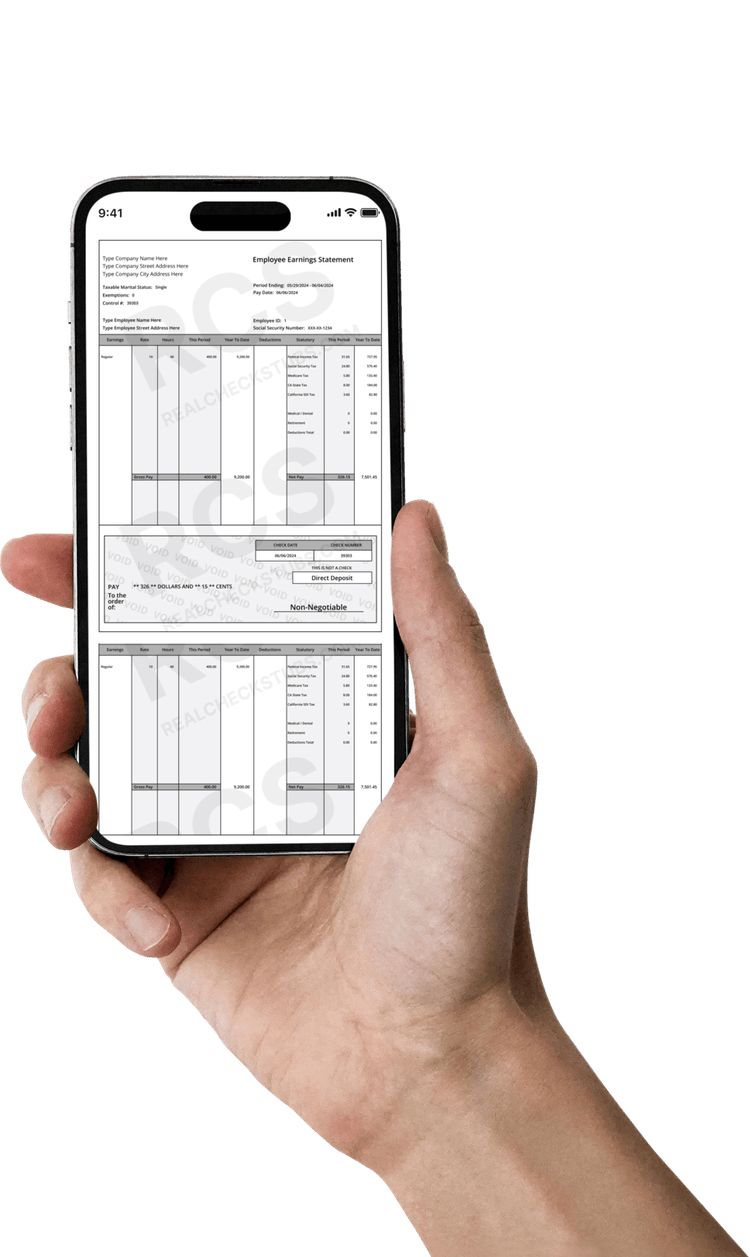
Estimate Your Illinois Take-Home Pay
See exactly what you'll take home at 2026 rates: federal tax, Social Security, Medicare, and Illinois's cut, itemized per paycheck.
| Line | Per paycheck | Per year |
|---|
Want the math for a different state? Try the full paycheck calculator for all 50 states.
Estimate only. Actual withholdings depend on your W-4 elections, employer benefits, and local deductions. This tool does not constitute tax advice.
Illinois Payroll Tax Overview
Flat State Income Tax
Illinois charges a single flat income tax rate. For 2026 that rate is 4.95% on taxable income, with a personal exemption allowance of $2,925 per person. The flat rate is written into the Illinois Constitution, so it applies the same way whether you earn $30,000 or $300,000. A 2020 ballot measure to switch to a graduated rate failed, and no rate change is scheduled for 2026.
The biggest thing to know about Illinois is what is not on your stub. There is no state disability insurance (SDI) deduction, no paid family leave payroll tax, and no employee-paid unemployment tax. State unemployment insurance (SUI) is paid entirely by the employer, on the first $14,250 of wages in 2026. On the state side, the only mandatory withholding line is the 4.95% income tax.
No Local Income Taxes
This is where Illinois differs sharply from neighbors like Indiana, which adds county income taxes, or states like Ohio and Kentucky with city and school-district taxes. No municipality in Illinois levies a local income tax, including Chicago. If you see a "Chicago tax" line on a stub, it is wrong. Chicago regulates wages and paid leave, not income tax withholding.
Illinois Secure Choice (Now My Illinois Savings)
If your employer does not offer a 401(k) or similar plan, you may see a retirement deduction tied to the state program. Illinois requires employers with five or more employees, in business at least two years, to either offer a qualified plan or enroll workers in the state-facilitated Roth IRA. The default deduction is 5% of pay, taken after tax, and it auto-escalates 1% per year up to 10% unless you change or opt out within 30 days.
In June 2026 this program is rebranding from Illinois Secure Choice to My Illinois Savings, with Vestwell taking over as program manager. The deduction itself does not change. It still appears as an after-tax retirement line on your stub, separate from any pre-tax 401(k) figure.
Illinois Paystub Requirements
Mandatory Pay Stub Law (2025)
As of January 1, 2025, Illinois law requires employers to give every employee a pay stub for each pay period. This came from an amendment to the Illinois Wage Payment and Collection Act (820 ILCS 115). Before this change, Illinois had no standalone stub-content statute, so the rules below are recent and strictly enforced.
Most Illinois employees must be paid at least semi-monthly (twice a month). Executive, administrative, and professional staff can be paid monthly, and commissions can be paid monthly. Stubs can be delivered on paper or electronically, and the law does not require the employee to consent to electronic delivery.
Required Information on the Stub
Under the 2025 rules, each Illinois pay stub must itemize:
- Hours worked — Total hours in the pay period
- Rate of pay — The employee's regular hourly or salary rate
- Overtime hours and pay — OT hours separately, plus OT earnings
- Gross wages earned — Total before deductions
- Deductions — Each deduction taken from wages
- Year-to-date totals — Cumulative wages and deductions for the year
The year-to-date column matters most at tax time, because those running totals should line up with your W-2. When you create a pay stub for an Illinois worker, the YTD wage and deduction fields are part of what makes it compliant rather than just a printout.
Record Retention and Copy Requests
Employers must keep a copy of each pay stub for at least three years from the pay date, even if the worker has already left. Current and former employees can request copies, and the employer has 21 calendar days to provide them. Requests are limited to twice in a 12-month period, and former employees can request up to one year after separation.
There is a civil penalty of up to $500 per violation for failing to follow these rules. If an employer only provides stubs electronically and a departing worker would lose access within a year, the employer must offer the prior year of stubs by the final pay period and document the response.
Special Situations in Illinois
Tipped Workers and the Chicago Wage Rules
Illinois allows a tip credit, but it is capped. The statewide tipped minimum is $9.00 per hour (60% of the $15.00 minimum), and tips plus base pay must reach the full $15.00 each workweek or the employer covers the gap. Chicago runs its own higher rates and its own tip rules, so a server in Chicago and a server in Springfield are on different numbers.
| Location (2026) | Standard minimum | Tipped minimum |
|---|---|---|
| Illinois statewide | $15.00 | $9.00 |
| Chicago (now, 4+ employees) | $16.60 | $12.62 |
| Chicago (from July 1, 2026) | $17.05 | $12.96 |
| Cook County, outside Chicago (now) | $15.00 | $9.00 |
| Cook County (from July 1, 2026) | $15.40 | $9.25 |
Chicago had been phasing out its tip credit under the One Fair Wage ordinance, but the City Council voted in 2026 to pause that phaseout. The tipped wage holds at $12.96 after July 1, 2026, rather than continuing to climb. Note that over 80% of Cook County municipalities have opted out of the county wage ordinance, so suburban rates vary by town.
Public-Sector and Pension Deductions
Illinois public employees see pension contributions on their stubs that private workers do not. Teachers outside Chicago contribute to TRS (9.0%), Chicago teachers to CTPF, university staff to SURS (8.0%), local government workers to IMRF (4.5%), and state employees to SERS. These contributions are generally pre-tax for Illinois purposes, which lowers the state wages reported in W-2 Box 16. Many Illinois public workers do not pay into Social Security, so their FICA lines look different from a private-sector stub.
When You Need an Illinois Paystub
Illinois renters feel this most in Chicago, where landlords and management companies routinely ask for recent stubs and often want gross monthly income at two to three times the rent. The same goes for apartment hunting in higher-cost suburbs like Naperville, Evanston, and Schaumburg. A clean stub with correct YTD totals is usually the fastest way to clear an application.
Stubs also come up for Illinois state programs and verification. Applications for SNAP and Medicaid through the Illinois Department of Human Services ask for recent pay records, and the state's ABE/manage-my-case system uploads them directly. Self-employed Illinois workers and rideshare drivers around Chicago and the Metro East often need self-generated stubs to document income for auto loans, mortgages, and leases. If you need proof of income, you can generate a pay stub with accurate Illinois withholding in a few minutes.
Illinois W-2 Requirements and Reporting
Your paychecks all year add up to your W-2. The year-to-date gross wages, the Illinois tax withheld, and your deductions on your final December stub should match the totals your employer reports in January. If they do not match, the stub is your evidence to get it fixed.
Because Illinois has a flat tax and no local income tax, the state section of an Illinois W-2 is short:
- Box 15: "IL" plus the employer's Illinois withholding account number.
- Box 16: Illinois state wages. These can differ from federal Box 1 if you have pre-tax items the state treats differently, including public pension contributions.
- Box 17: Illinois income tax withheld, reflecting the flat 4.95% rate applied across the year.
- Boxes 18–20 (local): Usually blank for Illinois workers, because no Illinois city or county imposes an income tax. If these boxes show amounts, that almost always points to a different state.
- Box 14: Sometimes used to report pension contributions (TRS, SURS, IMRF, and similar) for public employees.
Reciprocal State Agreements
Illinois has a reciprocal agreement with Iowa, Kentucky, Michigan, and Wisconsin, so residents of those states who work in Illinois can have their home-state tax withheld instead of Illinois tax, and vice versa, by filing the right exemption form. An Illinois resident working in a non-reciprocal state may see two states in Box 15 and can claim a credit to avoid double taxation.
Generate Your Illinois W-2 Form
Need to produce year-end forms too? Our Illinois W-2 Generator fills the state boxes with the flat-rate withholding and leaves the local boxes correctly empty, so the form matches the stubs you issued during the year.
Ready to generate your Illinois paystub?
820 ILCS 115–compliant with YTD totals, flat-rate state tax, and instant PDF delivery.
No accounting knowledge needed.
Illinois Paystub Questions
Does Illinois require employers to provide pay stubs?
Yes. Since January 1, 2025, Illinois employers must give every employee an itemized pay stub for each pay period. The stub must show hours worked, pay rate, overtime, gross wages, deductions, and year-to-date totals.
How much tax does Illinois take out of your paycheck?
Illinois withholds a flat 4.95% state income tax on taxable wages, after a $2,925 per-person exemption allowance for 2026. There is no separate state disability, paid leave, or employee unemployment tax. Federal income tax and FICA are withheld on top of that.
Does Illinois have any local or city income taxes on my paycheck?
No. No city or county in Illinois, including Chicago, levies a local income tax. Chicago and Cook County regulate minimum wage and paid leave, but not income tax withholding.
What is the minimum wage in Illinois in 2026?
The statewide minimum is $15.00 per hour for workers 18 and older, with no increase scheduled for 2026. Chicago is higher, rising from $16.60 to $17.05 on July 1, 2026, for employers with four or more employees. Workers under 18 who work fewer than 650 hours a year can be paid $13.00.
What is the tipped minimum wage in Illinois?
The statewide tipped minimum is $9.00 per hour, and tips plus wages must reach $15.00 for the week. In Chicago the tipped minimum is higher — $12.62 now and $12.96 starting July 1, 2026, after the city paused its tip-credit phaseout.
How long must Illinois employers keep pay stubs?
At least three years from the date of payment, even after the employee leaves. Employees and former employees can request copies, which the employer must provide within 21 calendar days, up to twice in a 12-month period.
Why is there a "My Illinois Savings" or Secure Choice deduction on my stub?
That is the state-facilitated retirement program for workers whose employer offers no qualified plan. It defaults to a 5% after-tax Roth contribution and auto-increases 1% per year unless you opt out or adjust it. Illinois Secure Choice is rebranding to My Illinois Savings in June 2026.
What do the state boxes on an Illinois W-2 show?
Box 15 shows "IL" and the employer's state tax ID, Box 16 shows your Illinois wages, and Box 17 shows the 4.95% tax withheld. The local boxes (18 to 20) are normally blank because Illinois has no local income tax.
References
- Illinois Department of Revenue — Booklet IL-700-T Withholding Tax Tables (2026)
- Illinois Department of Revenue — FY 2026-15 What's New for Illinois Income Taxes
- Illinois Wage Payment and Collection Act — 820 ILCS 115
- Illinois Department of Labor — Pay Stub Requirement (effective January 1, 2025)
- Illinois Department of Labor — Minimum Wage
- City of Chicago — Minimum Wage
- Cook County — Minimum Wage Ordinance and Regulations
- Illinois State Treasurer — Secure Choice / My Illinois Savings