
Texas Paystub Generator
Texas workers keep more of every paycheck than employees in most states — there's no state income tax here. But your paystub still needs to show federal withholding, FICA, and any voluntary deductions accurately. Whether you're a Permian Basin contractor, a Houston healthcare worker, or a self-employed freelancer in Austin, our paystub generator handles Texas payroll correctly and delivers a professional PDF in under two minutes.
💰 Money-back guarantee ⚡ Instant delivery
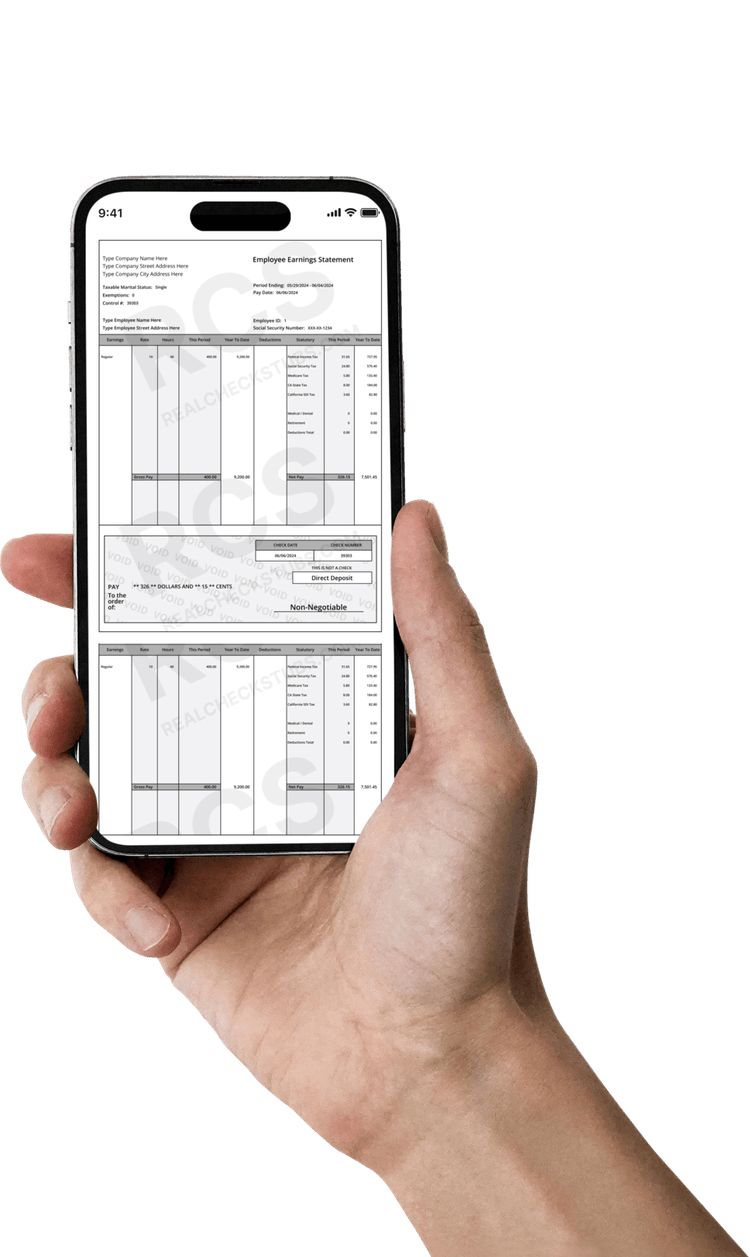
Estimate Your Texas Take-Home Pay
See exactly what you'll take home at 2026 rates: federal tax, Social Security, Medicare, and Texas's cut, itemized per paycheck.
| Line | Per paycheck | Per year |
|---|
Want the math for a different state? Try the full paycheck calculator for all 50 states.
Estimate only. Actual withholdings depend on your W-4 elections, employer benefits, and local deductions. This tool does not constitute tax advice.
Texas Payroll Tax Overview
State Income Tax
Texas has no state personal income tax and, under an amendment to the Texas Constitution passed by voters in November 2025, is now also permanently prohibited from taxing individual capital gains. This means your Texas paystub will never show a state income tax withholding line — every dollar of your gross wages is yours before federal taxes touch it.
What does appear on every Texas paystub is the full federal picture: income tax withheld based on your W-4 filing status and allowances, Social Security at 6.2% on wages up to $176,100, and Medicare at 1.45% on all wages. For higher earners, the Additional Medicare Tax of 0.9% applies to wages above $200,000 for single filers or $250,000 for married filers.
Texas is one of nine states with no income tax, alongside Alaska, Florida, Nevada, New Hampshire, South Dakota, Tennessee, Washington, and Wyoming. The practical difference shows up fast: a Texas worker earning $80,000 a year takes home roughly $4,000–$6,000 more annually than an equivalent worker in California or New York, depending on filing status.
State-Specific Mandatory Deductions
Texas has no state disability insurance (SDI), no paid family leave (PFL) program, and no employee-paid state unemployment contribution. The only unemployment tax in Texas — SUTA — is paid entirely by employers, not employees, at a rate between 0.23% and 6.23% on the first $9,000 of wages. None of this appears as a deduction on employee paystubs.
There are also no local income taxes anywhere in Texas. No city, county, or school district levies an income tax on wages. Unlike Ohio, Pennsylvania, or Kentucky — where dozens of municipalities tax worker paychecks — Texas residents pay zero local income tax regardless of which city or county they work in.
Recent Legislative Context (2026)
The Texas Constitution amendment passed in November 2025 permanently prohibits any future state income tax or capital gains tax, removing what had long been a political risk for the state's no-tax status. Additionally, Texas voters approved a $125,000 business personal property tax exemption effective January 1, 2026, which primarily affects small business owners rather than employees.
Texas Paystub Requirements
Mandatory Paystub Delivery
Texas is classified as an access/print state under payroll law. The Texas Payday Law requires employers to provide a written earnings statement — commonly called a paystub — every payday. Employers may deliver these electronically, but only if employees have a reasonable ability to access and print the record. An employer cannot simply email a PDF and call it done if the employee lacks the means to print it. The burden is on the employer to ensure genuine access.
This means Texas employers cannot silently switch to electronic-only delivery without confirming employees can actually use it. An employee who raises the issue can file a complaint with the Texas Workforce Commission, which has authority to investigate violations under Chapter 61 of the Texas Labor Code.
Required Information on a Texas Paystub
Under Texas labor law, every paystub must include the total amount of pay earned in the pay period, each deduction and its purpose, and the net amount after all deductions. The Texas Minimum Wage Act adds additional requirements for non-exempt employees, including hours worked and the applicable pay rate. For piece-rate workers, the number of units produced must also appear.
At minimum, a compliant Texas paystub contains: employee name, employer name, pay period dates, hourly rate or salary, total hours worked (for non-exempt employees), gross pay, all itemized deductions (federal income tax, Social Security, Medicare, and any voluntary deductions), and net pay.
Pay Frequency Requirements
Texas sets different pay frequency rules by employee classification. Non-exempt employees (those eligible for overtime) must be paid at least twice per month — semi-monthly at minimum. Exempt employees may be paid monthly. Employers who violate the Texas Payday Law's timing requirements face TWC complaints and potential back-pay orders.
Record Retention
Texas does not specify a state-level record retention period separate from the federal standard. Under the FLSA, employers must retain payroll records for three years and records relating to wage calculations for two years. Texas employers should use the federal three-year minimum as their floor.
Special Situations in Texas
Oil, Gas, and Energy Workers
Texas employs more than 490,000 workers directly in oil and natural gas, earning an average of $128,255 per year — 76% above the state's private-sector average. For these workers, paystub accuracy is critical and often complicated.
The most common payroll issue in the Texas energy sector is misclassification. Oilfield workers — particularly rig hands, pipeline technicians, and well-service contractors — are frequently treated as independent contractors when they legally qualify as employees, resulting in missing overtime pay and absent paystubs altogether. The U.S. Department of Labor has actively pursued Texas energy companies over these violations. If you work on a day-rate basis in the Permian Basin, the Eagle Ford Shale, or along the Gulf Coast refineries, verify whether your classification is correct. Employees are owed overtime; contractors are not.
For legitimate contractors in the energy sector, paystubs are not provided by clients — income appears on a 1099-NEC at year-end. A self-generated paystub from our paystub generator is often the only documentation available when these workers need proof of income for a mortgage or rental application.
Tipped Workers
Texas follows the federal tipped minimum wage of $2.13 per hour, with a maximum tip credit of $5.12. Combined tip income and direct wages must reach $7.25 per hour, or the employer must make up the difference. Texas has no additional tip credit restrictions beyond federal law, and there are no mandatory tip pooling rules specific to the state.
On a Texas paystub, tipped workers will see their direct cash wages as gross pay, with federal income tax withheld on declared tip income. The paystub does not separately break out tip amounts — that tracking happens on Form 4070 or through electronic tip reporting systems.
Texas State Employees and Teachers
State and local government employees in Texas participate in the Teacher Retirement System of Texas (TRS) or the Employees Retirement System of Texas (ERS), depending on their agency. Both systems appear as deductions on public-sector paystubs and are not subject to Social Security in most cases — Texas public employees are among the approximately 6.5 million government workers nationally who do not contribute to Social Security.
This means a Texas teacher's paystub looks different from a private-sector worker's: no Social Security withholding (6.2%), but a TRS contribution of 8.25% of gross salary instead. Medicare (1.45%) still applies.
When You Need a Texas Paystub
The most common Texas-specific use cases for paystubs are driven by the state's housing market and independent workforce.
Texas has seen aggressive rent growth in its major metros — Austin, Dallas-Fort Worth, Houston, and San Antonio all rank among the fastest-appreciating rental markets in the country. Landlords in these markets routinely require two to three months of paystubs as proof of income, and many require documentation showing income at 2.5× to 3× monthly rent. For workers who recently started a job, changed employers, or receive irregular income, our check stub maker produces the documentation landlords expect.
Texas also has one of the highest concentrations of self-employed and 1099 workers nationally, particularly in construction, technology, and oil services. These workers have no employer-generated paystubs. When applying for SBA loans, conventional mortgages, or state programs like the Texas State Affordable Housing Corporation, self-employed individuals need organized income documentation. A properly generated paystub showing consistent earnings is often accepted alongside tax returns.
For state-administered programs, including Medicaid, CHIP, and SNAP in Texas, the Health and Human Services Commission requires recent income verification. Paystubs from the last 30 days are the standard accepted format.
Texas W-2 Requirements and Reporting
Your final Texas paystub of the year is the document to cross-reference when your W-2 arrives. The year-to-date totals in Box 1 (federal wages) and Box 4 (Social Security withheld) should match your last paystub's cumulative figures almost exactly, with minor differences explained by pre-tax deductions like 401(k) contributions or health insurance premiums.
State Tax Reporting on Texas W-2s
Because Texas has no state income tax:
- Box 15 will show "TX" as the state abbreviation and your employer's Texas state tax ID, but this is an identification field — no withholding number accompanies it.
- Box 16 (state wages) will typically mirror Box 1 or be blank, depending on your employer's payroll software. There is nothing unique about Texas state wages because they are not separately taxed.
- Box 17 (state income tax withheld) will show $0.00 or be left blank. If you see any dollar amount in Box 17 on a Texas W-2, contact your payroll department immediately — this indicates an error.
- Boxes 18–20 (local wages and taxes) will be blank for all Texas employees, as no Texas jurisdiction imposes a local income tax.
Multi-State Workers
Texas residents who work remotely for employers in other states face a more complex W-2. Your employer may withhold income tax for the state where their business is located, even if you work entirely from Texas. Whether that withholding was correct depends on the specific state's rules — some states (like New York) tax non-residents on all income earned from companies located there. If you see out-of-state withholding on your W-2, review your state allocation or consult a tax professional.
Conversely, Texas workers who temporarily work in other states — traveling consultants, oilfield workers on assignment in North Dakota or Pennsylvania — may owe income tax in those states. Your Texas W-2 boxes 15–17 will still show Texas and $0, but you may receive a separate W-2 or need to file in the other state.
Verifying Your W-2 Against Your Paystubs
Compare your final December paystub's year-to-date totals with your W-2:
- YTD gross pay should closely match Box 1 (after pre-tax deductions are subtracted)
- YTD Social Security withheld should match Box 4 (capped at $10,918.20 for 2026, which is 6.2% × $176,100)
- YTD Medicare withheld should match Box 6
- Boxes 15–17 confirm $0 Texas state tax — if any of those figures are nonzero, there's an error
Generate Your Texas W-2 Form
Need to create a W-2 for Texas employees? Our Texas W-2 Generator handles the state fields automatically — Box 15 populates with TX, Box 17 correctly shows $0, and the form reflects the no-income-tax status without manual intervention. Generate accurate W-2 forms in minutes.
Ready to generate your Texas paystub?
Create a professional, IRS-compliant paystub in under 2 minutes.
No accounting knowledge needed.
Texas Paystub Questions
Does Texas require employers to provide paystubs?
Yes. The Texas Payday Law requires employers to provide a written earnings statement every payday showing how wages were calculated. Electronic paystubs are permitted, but only when employees have genuine access to view and print them. An employer who provides digital-only paystubs without ensuring printability is not fully compliant. If your employer refuses to provide a paystub, you can file a complaint with the Texas Workforce Commission — the filing deadline under the Texas Payday Law is 180 days from when wages were due.
Why is there no state income tax line on my Texas paystub?
Texas has no state personal income tax. The Texas Constitution prohibits it, and a voter-approved amendment passed in November 2025 now also permanently prohibits any future capital gains tax at the state level. Your Texas paystub will only show federal income tax, Social Security (6.2%), and Medicare (1.45%) as mandatory withholdings. A no-income-tax state means your gross-to-net gap is smaller than in states like California or New York — you keep more of each paycheck.
What are the pay frequency requirements in Texas?
Texas law requires non-exempt employees (those entitled to overtime) to be paid at least twice per month — semi-monthly at minimum. Exempt employees may be paid monthly. Some employers pay weekly or bi-weekly, which exceeds the minimum requirement and is perfectly legal. The pay period dates must appear on your paystub. If your employer pays you less frequently than semi-monthly and you are non-exempt, that is a Texas Payday Law violation.
How does Texas handle tipped employees on paystubs?
Texas follows the federal tipped minimum wage of $2.13 per hour. Your paystub will show your direct wages at that rate, but your total hourly compensation — including tips — must average at least $7.25. If it doesn't in any given pay period, your employer must pay the difference. Your paystub shows your direct wages and any employer make-up pay, but it does not separately itemize tips. Tip income is tracked and reported separately on Form 4070 or through your employer's tip reporting system, and it is subject to federal income tax withholding.
I'm a Texas oil field contractor — do I get paystubs?
Independent contractors in Texas do not receive paystubs from clients. You receive a Form 1099-NEC at year-end instead. However, if your working arrangement involves set hours, employer-provided equipment, and a supervisor telling you what to do — you may be misclassified. True employees are owed paystubs, overtime, and proper W-2 reporting. If you've been paid as a contractor but believe you are an employee, the TWC and U.S. Department of Labor both accept misclassification complaints. For contractors who need proof of income for a mortgage, rental, or loan application, our paystub generator can produce documentation of your earnings.
What should a Texas public school teacher's paystub show?
Texas public school teachers participate in the Teacher Retirement System of Texas (TRS) rather than Social Security. Your paystub will show a TRS contribution of 8.25% of your gross salary as a mandatory deduction, but no Social Security withholding (6.2%). Medicare (1.45%) still applies. Federal income tax is withheld normally. Because TRS replaces Social Security, you will not earn Social Security credits through your teaching work — something to factor into long-term retirement planning if you've worked in Social Security-covered jobs as well.
Does Texas have any local income taxes that appear on paystubs?
No. Texas has no city, county, or school district income taxes anywhere in the state. Unlike Ohio (where over 600 municipalities levy local income taxes) or Pennsylvania (where nearly every jurisdiction does), Texas workers pay zero local income tax regardless of where in the state they live or work. Nothing local appears on your paystub beyond what the employer chooses to report.
How long must Texas employers keep payroll records?
Texas does not set a state-specific payroll record retention period beyond the federal standard. Under the Fair Labor Standards Act, employers must retain basic payroll records for three years and records related to wage calculations (time cards, wage rate tables) for two years. The three-year window is the practical minimum. Employees who believe they were underpaid have up to two years to file an FLSA claim (three years for willful violations), so keeping records for at least three years protects both parties.
My W-2 shows something in Box 17 — is that an error?
Almost certainly yes. Box 17 on a W-2 shows state income tax withheld. Texas has no state income tax, so Box 17 should be blank or show $0.00 for all Texas workers. If you see a dollar amount there, contact your payroll department or HR immediately. The most likely causes are a data entry error, a system configuration issue showing withholding for the wrong state, or multi-state work where out-of-state tax was inadvertently coded to the Texas withholding field. Request a corrected W-2c if the error is not fixed on the original form.
Can I use a paystub generator for Texas rental applications?
Yes, and it's common in Texas's competitive rental markets. Major Texas cities — Austin, Dallas, Houston, San Antonio — have some of the highest rent-to-income ratios in the country, and landlords routinely require two to three months of paystubs showing income at 2.5× to 3× the monthly rent. Our paystub generator produces professional, detailed paystubs that include all required Texas payroll fields. Self-employed individuals, 1099 contractors, and recently hired employees who lack employer-provided documentation use these routinely for rental verification.