What Does "Non-Negotiable" Mean on a Check?

"Non-negotiable" on a check means the document cannot be cashed or deposited.
It is a record, not money, and most of the time it is the stub attached to a direct deposit paycheck. If your paycheck is stamped this way, your wages have almost certainly already landed in your bank account.
Below is exactly what the label means, why it shows up on your pay stub, whether you can ever deposit one, and what to do if you are holding a check marked non-negotiable.
What "Non-Negotiable" Means on a Check
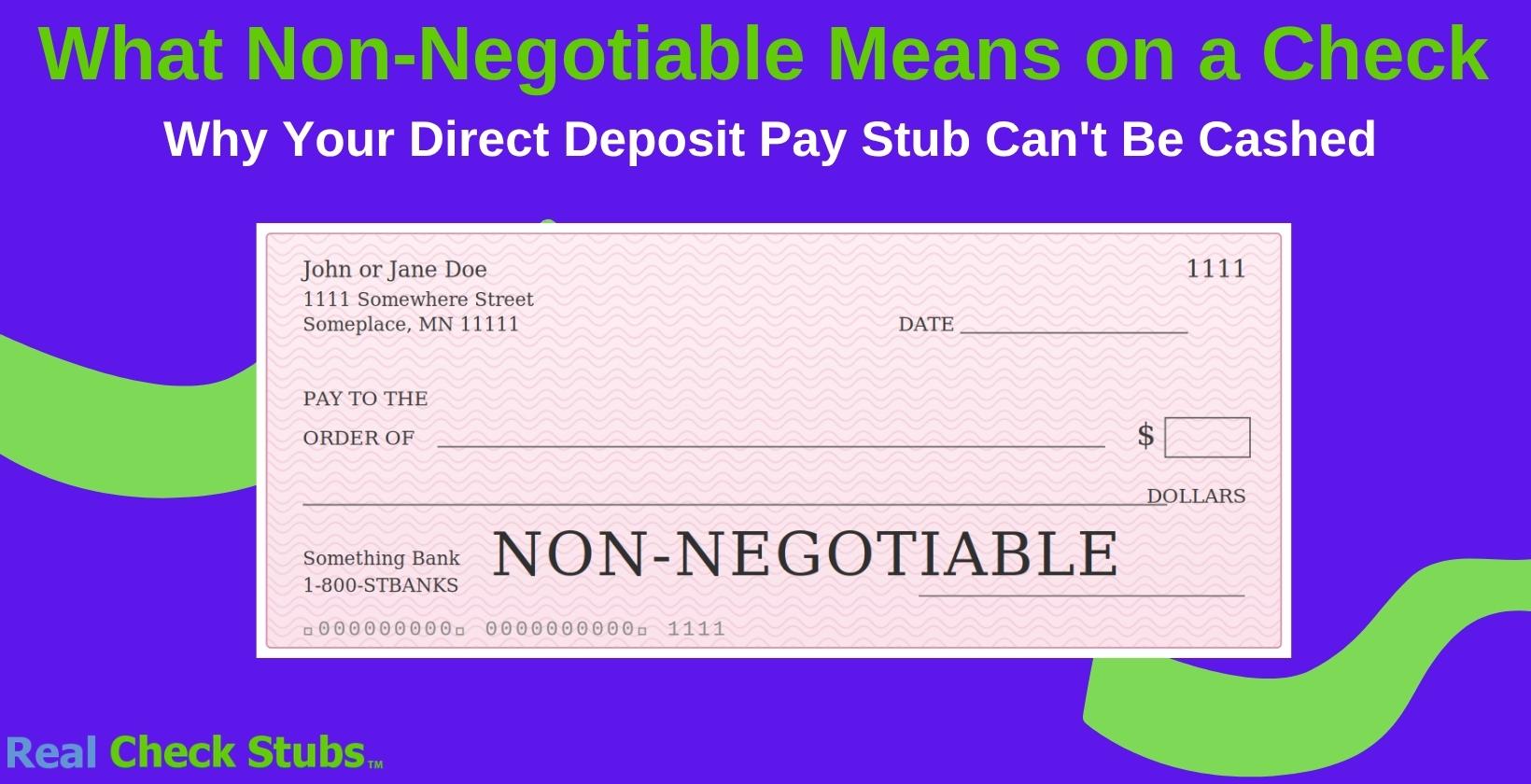
A negotiable instrument is a document that carries a genuine order to pay and can be transferred, cashed, or deposited. A non-negotiable check fails that test. The label tells the bank not to treat the paper as money.
Under the Uniform Commercial Code (UCC 3-104), a real check needs an unconditional order to pay a fixed amount. Pay stubs, specimen checks, and deposit advice slips never meet that standard in the first place. The "non-negotiable" stamp simply makes that status obvious at a glance.
So in plain terms, a non-negotiable check is a look-alike. It uses the familiar check layout for clarity, but it was never intended to move money on its own.
Why Your Paycheck or Pay Stub Says "Non-Negotiable"
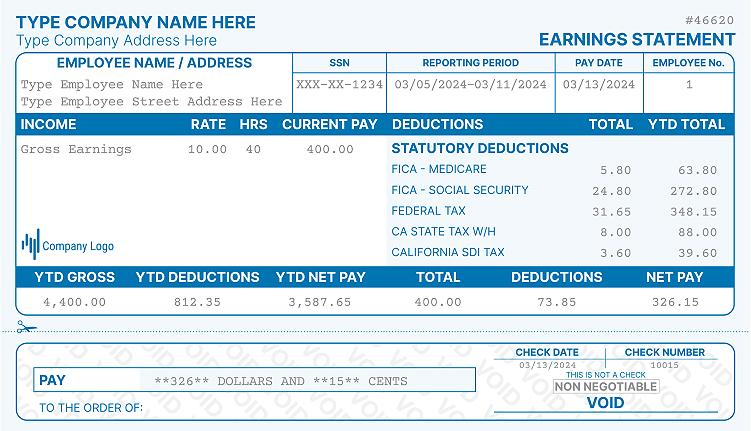
The most common reason is direct deposit. When your employer pays you electronically, a paper check is unnecessary, so payroll software prints "non-negotiable" across the check portion. This stops anyone from depositing it a second time after the money already moved through the ACH network.
That means the paper you are holding is a receipt, not a paycheck. It documents your gross pay, deductions, and net pay so you have a record of the transaction. The actual funds were sent straight to your account on payday.
This is why the phrase often appears next to text like "this is not a check" on the stub. It is confirming a payment that has already happened.
If you need a clean copy of your earnings for your own records, a pay stub generator can reproduce your gross wages, deductions, and net pay from a direct deposit for legitimate personal recordkeeping.
Can You Cash or Deposit a Non-Negotiable Check?
No. A bank or credit union will not cash or deposit a check marked non-negotiable. If you tried, a teller would hand it back, and a mobile deposit would be rejected or later reversed.
There is nothing to collect because the document holds no funds. With a direct deposit stub, the money is already in your account. Trying to deposit the stub does not add a second payment.
Other Reasons a Check Is Marked Non-Negotiable
Direct deposit is the usual cause, but it is not the only one. The same label appears in a few other situations.
Voided or Specimen Checks
Employers and software vendors print sample checks for training, account setup, or template purposes. These are stamped "VOID" or "non-negotiable" so nobody mistakes them for real payment.
A Real-Looking Check With a Defect
Sometimes a teller calls a seemingly normal check non-negotiable because it has a problem. Common defects include a missing signature, a stale date (usually more than six months old), a missing or damaged MICR line, or signs of alteration. In that case the check needs to be corrected or reissued by the payer before it can be used.
A "Not Negotiable" Crossing
Some checks carry the words "not negotiable" written across two parallel lines. This is more common outside the United States. It does not void the check, but it limits transfer, so only the named payee can claim the funds and a later holder gains no greater right to the money.
Negotiable vs. Non-Negotiable Check
Here is a quick side-by-side to keep the two straight.
| Feature | Negotiable Check | Non-Negotiable Check |
|---|---|---|
| Can be cashed or deposited | Yes | No |
| Holds actual funds | Yes | No, it is a record only |
| Common example | A standard paycheck you take to the bank | A direct deposit pay stub |
| Purpose | Transfers money to the payee | Documents a payment or prevents misuse |
| Legal status (UCC 3-104) | Meets negotiable instrument rules | Does not meet the rules |
What to Do If You Received a Non-Negotiable Check
First, check whether you are on direct deposit. If you are, log in to your bank and confirm the net pay amount on the stub matches your deposit. In almost every case it will, and you simply keep the stub for your files.
If you expected a real paycheck and received a non-negotiable one by mistake, contact your employer's payroll department. Ask them to confirm your payment method and, if needed, reissue a negotiable check or correct your direct deposit details.
Keep the stub either way. A non-negotiable pay stub is useful proof of income for a mortgage application, apartment rental, or loan, alongside your regular pay stub records. Do not alter it, since changing an income document for submission to a lender or agency is fraud.
Frequently Asked Questions
Can you cash a non-negotiable check?
No. A non-negotiable check cannot be cashed or deposited at any bank. It is a record of a payment, not a source of funds.
Why does my paycheck say non-negotiable?
It almost always means you are paid by direct deposit, so the money already went to your bank account electronically. The paper is your pay stub, marked non-negotiable so it cannot be deposited a second time.
Can you deposit a non-negotiable check with mobile deposit?
No. A mobile or ATM deposit of a non-negotiable check will be rejected or later reversed. The document contains no payable funds to collect.
What do I do with a non-negotiable check?
Keep it as a record of your earnings and payment. If you were expecting a real check instead, contact your employer's payroll team to confirm your pay method or reissue it.
What makes a check non-negotiable?
A check is non-negotiable when it lacks a genuine order to pay, or when it is voided, a specimen, expired, unsigned, or altered. Direct deposit stubs are the most common example because the payment already happened.
References
- Cornell Law School, Legal Information Institute. U.C.C. § 3-104. Negotiable Instrument. https://www.law.cornell.edu/ucc/3/3-104
- Cornell Law School, Legal Information Institute. U.C.C. § 3-302. Holder in Due Course. https://www.law.cornell.edu/ucc/3/3-302
- Consumer Financial Protection Bureau. What is a check? https://www.consumerfinance.gov/ask-cfpb/what-is-a-check-en-943/
- Federal Reserve / FedACH. Automated Clearing House Services. https://www.frbservices.org/financial-services/ach
- Nacha. ACH Network and Direct Deposit. https://www.nacha.org/content/ach-network

Kristen Larson is a payroll specialist with over 10 years of experience in the field. She received her Bachelor's degree in Business Administration from the University of Minnesota. Kristen has dedicated her career to helping organizations effectively manage their payroll processes with Real Check Stubs.
Our all Posts