What Is Group-Term Life (GTL) on a Pay Stub?

GTL on a pay stub stands for Group-Term Life insurance, and it usually shows up not as money taken out of your check, but as "imputed income" added to your taxable wages.
If your employer provides more than $50,000 in group-term life coverage, the IRS requires that extra value to be taxed, even though you never actually receive that money in cash.
Here's exactly what GTL means, why it appears on your pay stub, and how to check whether the amount is calculated correctly.
Key Takeaways
- GTL stands for Group-Term Life insurance, a benefit many employers provide at no direct cost to employees.
- The IRS excludes the first $50,000 of employer-paid GTL coverage from taxable income under Section 79 of the tax code.
- Coverage above $50,000 creates imputed income, calculated using the IRS Table I rate chart based on your age.
- GTL imputed income is subject to Social Security and Medicare tax, but not federal income tax withholding.
- This $50,000 threshold has not changed for the 2026 tax year and remains a stable, long-standing rule.
- GTL imputed income appears on your W-2, typically noted in Box 12 with Code C.
What Does GTL Mean on a Pay Stub?
GTL is short for Group-Term Life insurance. It's a life insurance benefit that many employers offer as part of a standard benefits package, often at little or no direct cost to the employee.
When you see "GTL" on your pay stub, it's not a deduction pulling money out of your check in most cases. Instead, it's a notation showing the taxable value of employer-paid life insurance coverage above a certain limit.
This amount gets added to your gross wages for tax purposes, which is why your paycheck stub might show a GTL line even though your net pay hasn't actually decreased because of it. If you want to see exactly how GTL and other line items affect your gross-to-net calculation, a pay stub generator can help you map out how each pre-tax and post-tax item changes your final take-home pay.
Why Am I Getting Paid for Group-Term Life?
You're not actually being paid extra money for GTL. What's happening is that your employer is covering the premium for your life insurance policy, and the IRS treats part of that premium's value as taxable compensation once your coverage passes $50,000.
This is called imputed income: income you're taxed on without receiving the cash. Common examples include employer-paid life insurance over the threshold, some fringe benefits, and certain other non-cash perks.
So the GTL line on your stub reflects a tax obligation tied to a benefit you're receiving, not an extra payment landing in your bank account.
Is GTL Taxable?
Yes, but only above a specific dollar amount. Under Section 79 of the Internal Revenue Code, the first $50,000 of employer-provided group-term life insurance is excluded from your taxable income entirely.
If your coverage exceeds $50,000, the value of the coverage above that amount becomes imputed income. That imputed income is:
- Subject to Social Security tax (6.2%)
- Subject to Medicare tax (1.45%)
- Generally not subject to federal income tax withholding at the time it's imputed, though it still counts as taxable income reported on your W-2
The $50,000 exclusion has remained unchanged for years, including for the 2026 tax year. It's one of the more stable thresholds in the tax code.
How GTL Imputed Income Is Calculated (Table I)
Employers don't use the actual premium cost to calculate GTL imputed income. Instead, they use a standardized IRS rate chart called Table I, which assigns a monthly cost per $1,000 of coverage based on your age.
| Age Bracket | Monthly Cost per $1,000 of Coverage |
|---|---|
| Under 25 | $0.05 |
| 25 to 29 | $0.06 |
| 30 to 34 | $0.08 |
| 35 to 39 | $0.09 |
| 40 to 44 | $0.10 |
| 45 to 49 | $0.15 |
| 50 to 54 | $0.23 |
| 55 to 59 | $0.43 |
| 60 to 64 | $0.66 |
| 65 to 69 | $1.27 |
| 70 and older | $2.06 |
Example: Say you're 52 years old with $150,000 in employer-paid GTL coverage. Subtract the $50,000 exclusion, leaving $100,000 in excess coverage, or 100 units of $1,000.
Multiply 100 units by the age-52 rate of $0.23, which equals $23 per month in imputed income. Over a full year, that's $276 added to your taxable wages, even though you never received that amount as cash.
GTL Deduction vs. GTL Imputed Income
It helps to separate two things people often confuse. A "GTL deduction" usually refers to money taken from your check if you're paying for supplemental or voluntary life insurance coverage yourself, either pre-tax or after-tax.
"GTL imputed income," on the other hand, is not a deduction at all. It's an addition to your taxable wages that reflects the value of coverage your employer already paid for above the $50,000 limit.
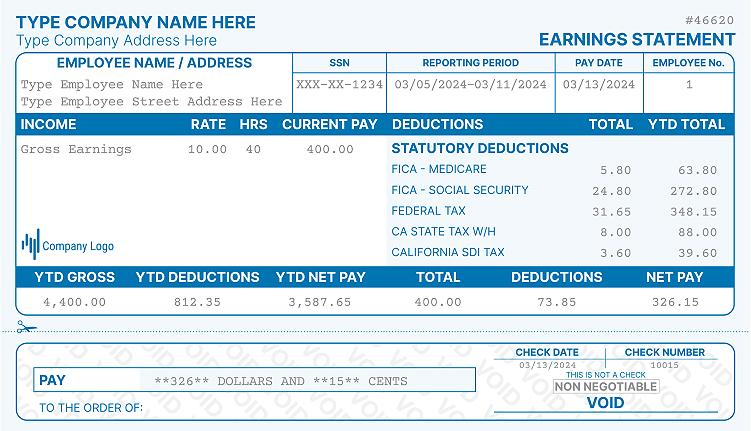
Some pay stubs list both a GTL deduction (what you're paying) and a GTL imputed income line (what you're being taxed on) separately. Checking your paystub closely, or comparing it against a sample layout, can help you tell which one applies to your situation.
Where GTL Shows Up on Your W-2
GTL imputed income doesn't just appear on your pay stub. It also flows through to your year-end tax documents. On your W-2, employer-paid group-term life insurance in excess of $50,000 is typically reported in Box 12 with Code C, and the taxable amount is already included in Box 1 (wages), Box 3 (Social Security wages), and Box 5 (Medicare wages).
If you're an employer or need to issue a W-2 that correctly reflects GTL imputed income for payroll recordkeeping, a W-2 form maker can help you generate an accurate, properly formatted form.
Does GTL Work Differently in California?
The federal rules under Section 79 and the Table I rate chart apply the same way in every state, including California. There isn't a separate "California GTL" calculation for federal tax purposes.
What can differ is state income tax treatment. California generally follows the federal approach to imputed income for group-term life insurance, but state tax withholding rules can vary by employer and payroll system. If your California pay stub shows a GTL amount that looks off, your best move is asking your payroll or HR department to walk through how it was calculated for your specific state filing.
What to Do If Your GTL Amount Looks Wrong
If the GTL line on your pay stub or W-2 doesn't match what you'd expect, a few things are worth checking:
- Confirm your total employer-paid coverage amount with HR or your benefits portal.
- Verify your age bracket, since Table I rates are based on your age as of December 31 of the tax year.
- Ask whether the calculation includes only the coverage above $50,000, not your full policy amount.
- Request a corrected pay stub or W-2c if there's a genuine calculation error.
Keeping your own copies of pay stubs throughout the year makes it easier to catch discrepancies before tax season. A paystub generator can also help you create clean, accurate records if you ever need to reconstruct your earnings history.
Frequently Asked Questions
What does GTL stand for?
GTL stands for Group-Term Life insurance, a life insurance benefit many employers provide as part of their standard benefits package.
Why am I getting paid for group-term life?
You're not actually being paid extra. The GTL line reflects imputed income, the taxable value of employer-paid life insurance coverage above $50,000.
Is GTL taxable?
Only the portion of coverage above $50,000 is taxable. The first $50,000 of employer-paid group-term life insurance is excluded from your income under Section 79.
Can you cash out group-term life insurance?
No. Group-term life insurance has no cash value and ends when you leave your employer or the policy terminates, unlike permanent life insurance policies.
What is a GTL claim?
A GTL claim refers to a beneficiary filing for the death benefit payout after the insured employee passes away, submitted directly to the group insurance carrier through the employer.
References
- IRS. (2025). Publication 15-B, Employer's Tax Guide to Fringe Benefits. https://www.irs.gov/publications/p15b
- IRS. Internal Revenue Code Section 79, Group-Term Life Insurance Purchased for Employees.
- IRS. Treasury Regulation §1.79-3, Table I Uniform Premiums.

Allen Wood is an accomplished accountant with over 15 years of experience in the field.
Our all Posts