No Tax on Overtime: How Qualified Overtime Shows on Your Pay Stub and W-2

No tax on overtime is a federal income tax deduction of up to $12,500 a year ($25,000 on a joint return) for the overtime premium the Fair Labor Standards Act (FLSA) requires, which is the extra "half" in time-and-a-half pay. The deduction applies to tax years 2025 through 2028. Starting with 2026 wages, employers report this qualified overtime on Form W-2 in Box 12 with Code TT, so workers receiving W-2s by February 1, 2027 will see the code for the first time.
The overtime premium is not tax-free on the paycheck itself; workers claim the deduction when they file.
Qualified Overtime vs. Regular Overtime Pay
Qualified overtime compensation is the portion of overtime pay above an employee's regular rate that the FLSA requires for hours worked over 40 in a workweek. For time-and-a-half overtime, that is the half-time premium, not the full overtime check. An employee earning $20 an hour who works 10 overtime hours at $30 an hour receives $300 of overtime pay, of which $100 is qualified overtime and $200 is regular-rate pay.
The following are the 4 types of overtime pay that do not count as qualified overtime:
- Overtime paid at the regular rate, with no premium.
- Overtime required only by state law or a union contract, such as daily overtime the FLSA does not require.
- Any premium above time-and-a-half, such as the extra half in double time.
- Overtime paid to exempt employees, such as most salaried managers and professionals.
Independent contractors are not covered by FLSA overtime rules, so 1099 income does not produce qualified overtime.
Code TT on the 2026 Form W-2
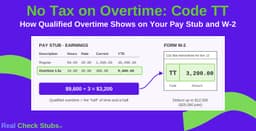
Qualified overtime appears in Box 12 of the 2026 Form W-2 with Code TT, showing the total qualified overtime the employer paid during the year. The 2026 Form W-2 added three Box 12 codes:
| Box 12 code | What it reports |
|---|---|
| TT | Total qualified overtime compensation |
| TP | Total cash tips reported to the employer that may qualify for the tips deduction |
| TA | Employer contributions to a Trump account |
The Code TT amount is a starting figure, not the deduction itself. An employee with $16,000 in Code TT still deducts no more than $12,500 on a single return. Code TT is also already included in Box 1 wages, so it is not extra income. The full list of letter codes is in the guide to W-2 Box 12 codes.
Forms W-2 for 2025 wages have no Code TT. Employers were not required to report qualified overtime separately for 2025, so workers filing 2025 returns calculate the amount themselves from pay stubs or an employer statement.
Calculating Qualified Overtime From Your Pay Stub
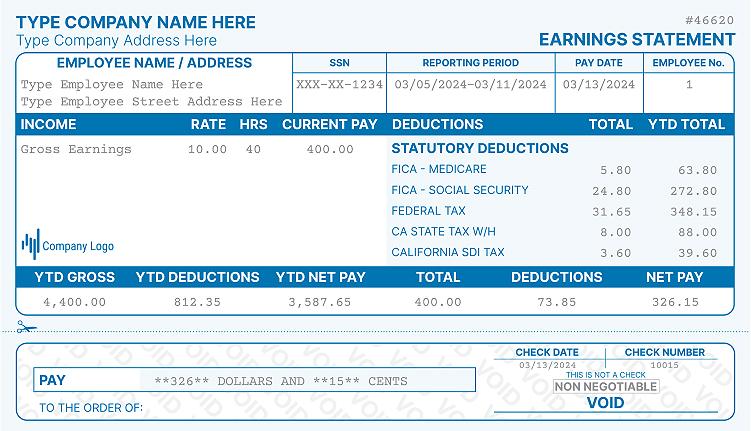
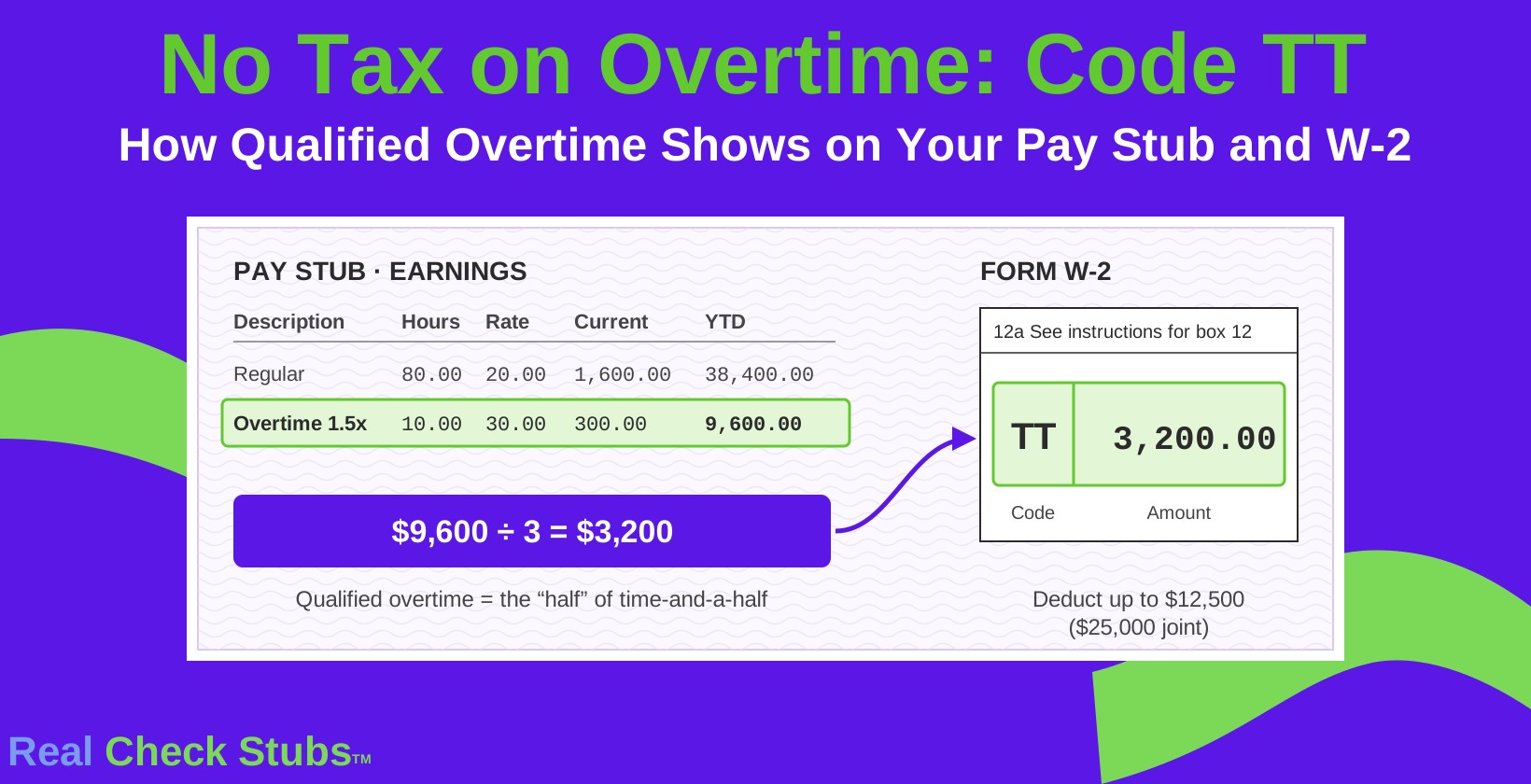
To find qualified overtime on a pay stub, take the overtime earnings line and divide it by 3 when overtime is paid at time-and-a-half. Overtime pay at 1.5 times the regular rate splits into one part premium and two parts regular rate, so one-third of the overtime line is the qualified premium. Most pay stubs show overtime as a separate earnings line labeled "OT," "Overtime," or "OT 1.5," with hours, rate, current amount, and year-to-date amount.
The following are the 4 steps to check qualified overtime from pay stubs:
- Find the overtime earnings line on your most recent pay stub of the year.
- Take the year-to-date overtime amount from that line.
- Divide the year-to-date amount by 3 for time-and-a-half overtime.
- Compare the result with Code TT on your W-2.
A warehouse worker whose final 2026 pay stub shows $9,600 in year-to-date overtime at time-and-a-half has $3,200 of qualified overtime ($9,600 ÷ 3). A Code TT amount close to $3,200 confirms the W-2. A small gap can be legitimate, because the FLSA regular rate includes some bonuses and shift differentials, which raises the premium above a simple one-third. A large gap, or a missing Code TT, is worth raising with payroll. The guide to reading a pay stub explains each earnings line.
Claiming the Deduction on Schedule 1-A
Claim the no tax on overtime deduction on Schedule 1-A, filed with Form 1040, using the Code TT amount from your W-2. The deduction is available whether you take the standard deduction or itemize. The following are the 4 eligibility rules:
- The overtime is required by the FLSA and reported on a W-2 or other qualifying statement.
- You have a valid Social Security number.
- You file a joint return if you are married.
- Your modified adjusted gross income stays under the phase-out range.
The deduction phases out above $150,000 of modified adjusted gross income ($300,000 joint). It drops by $100 for every $1,000 over the threshold, so a single filer with the full $12,500 deduction loses all of it at $275,000.
The deduction reduces federal income tax only. Social Security and Medicare taxes still apply to all overtime pay, and state income tax treatment depends on whether your state follows the federal deduction. Federal withholding on each paycheck also stays the same unless you update Form W-4, which is why pay stubs show no change in withholding on overtime.
Missing or Incorrect Code TT
If Code TT is missing or wrong on your 2026 W-2, ask your employer for a corrected Form W-2c before you file. Bring your final pay stub of the year, because the year-to-date overtime line shows the figure payroll should have reported. If the corrected form does not arrive before your filing deadline, the guide to fixing an incorrect W-2 covers your options.
Employers preparing W-2s for 2026 wages add Code TT for every non-exempt employee who earned FLSA overtime. The Real Check Stubs W-2 generator creates Form W-2 online, and the pay stub generator lists overtime as its own earnings line with year-to-date totals.
Frequently Asked Questions
Is overtime tax-free in 2026?
No, overtime is not tax-free. Workers deduct the FLSA overtime premium, up to $12,500 ($25,000 joint), from federal taxable income when filing. Social Security, Medicare, and possibly state income tax still apply to all overtime pay.
What does Code TT mean on a W-2?
Code TT in Box 12 of Form W-2 reports total qualified overtime compensation, the FLSA-required premium above the regular rate. Workers use this amount on Schedule 1-A to calculate the no tax on overtime deduction.
Is the whole overtime check deductible?
No, only the premium portion is deductible. For time-and-a-half, that is one-third of total overtime pay. A worker paid $3,000 in time-and-a-half overtime has $1,000 of qualified overtime compensation.
Why doesn't my pay stub show less tax on overtime?
Payroll withholds federal income tax on overtime the same way as before, because the deduction is claimed on the tax return. Workers who want smaller withholding during the year update Form W-4 with their employer.
Does double time count as qualified overtime?
Only partly. The FLSA requires time-and-a-half, so the qualified amount is half the regular rate per overtime hour. The extra premium above time-and-a-half in double time does not qualify.
Do salaried employees get no tax on overtime?
Salaried employees classified as exempt under the FLSA do not qualify, because the FLSA does not require overtime for them. Salaried non-exempt employees who receive FLSA overtime do qualify.
Can 1099 contractors claim no tax on overtime?
No, independent contractors are not covered by FLSA overtime rules, so payments reported on Form 1099 do not include qualified overtime compensation.
How long does the no tax on overtime deduction last?
The deduction applies to tax years 2025 through 2028. Without new legislation, overtime premium pay earned in 2029 and later is fully subject to federal income tax.
References
- IRS: Frequently Asked Questions on the Qualified Overtime Compensation Deduction
- IRS Notice 2025-69: Qualified Tips and Qualified Overtime Compensation Deductions
- IRS: One, Big, Beautiful Bill Provisions
- IRS: General Instructions for Forms W-2 and W-3
- 26 U.S. Code § 225: Qualified Overtime Compensation
- U.S. Department of Labor: Overtime Pay Under the FLSA

Allen Wood is an accomplished accountant with over 15 years of experience in the field.
Our all Posts