What Is ESPP (Employee Stock Purchase Plan) on My Pay Stub?

ESPP on your pay stub stands for Employee Stock Purchase Plan, and the line item is the after-tax money your employer is holding back from each paycheck to buy company stock for you later.
It is a deduction, not a tax and not a loss. That money is still yours, it is just sitting in a holding account until the next purchase date, when it converts into discounted shares.
Here is what the line actually means, why it comes out after tax instead of before, and what it turns into on your W-2.
Key Takeaways
- ESPP on a pay stub is an after-tax payroll deduction used to buy company stock at a discount, usually up to 15% off.
- The deduction appears under post-tax deductions, so it does not lower your Box 1 taxable wages the way a traditional 401(k) does.
- Money accumulates over an offering period (commonly 6 months) and buys shares on the purchase date, not every payday.
- Federal law caps qualified Section 423 plans at $25,000 of stock per calendar year, measured at grant-date fair market value.
- You owe no tax when the deduction comes out. Tax happens when you sell, and the compensation portion shows up in Box 1 and often Box 14 of your W-2.
- Your broker's Form 1099-B cost basis is frequently understated, which causes people to overpay. Use Form 3922 to fix it.
What Does ESPP Mean on a Pay Stub?
ESPP is short for Employee Stock Purchase Plan. It is a benefit that lets you buy your employer's stock through automatic payroll deductions, normally at a discount to market price.
When you enrolled, you picked a contribution rate, usually a percentage of your gross pay. Payroll now withholds that percentage every cycle and parks it with the plan administrator.
So the ESPP line on your pay stub is simply a record of how much was set aside this period. Your year-to-date column next to it shows how much has piled up toward the next purchase.
ESPP Is a Deduction, Not a Charge
This trips people up on their first stub after enrolling. Net pay drops, and it looks like a new tax.
It is not. The money converts into company shares you own outright, typically at 85% of market value or better.
Where ESPP Shows Up on Your Pay Stub
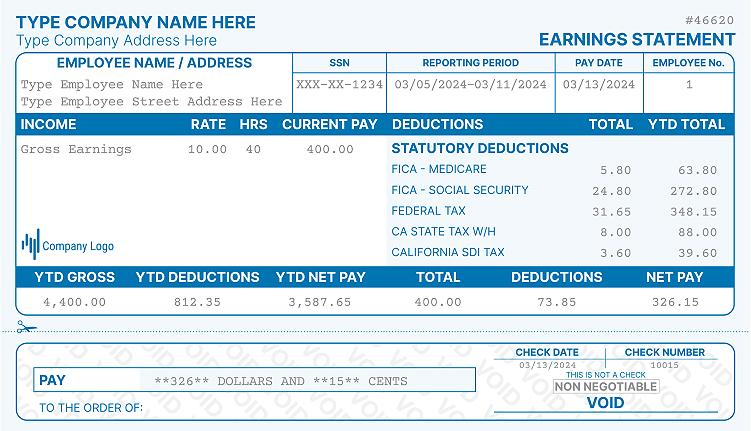
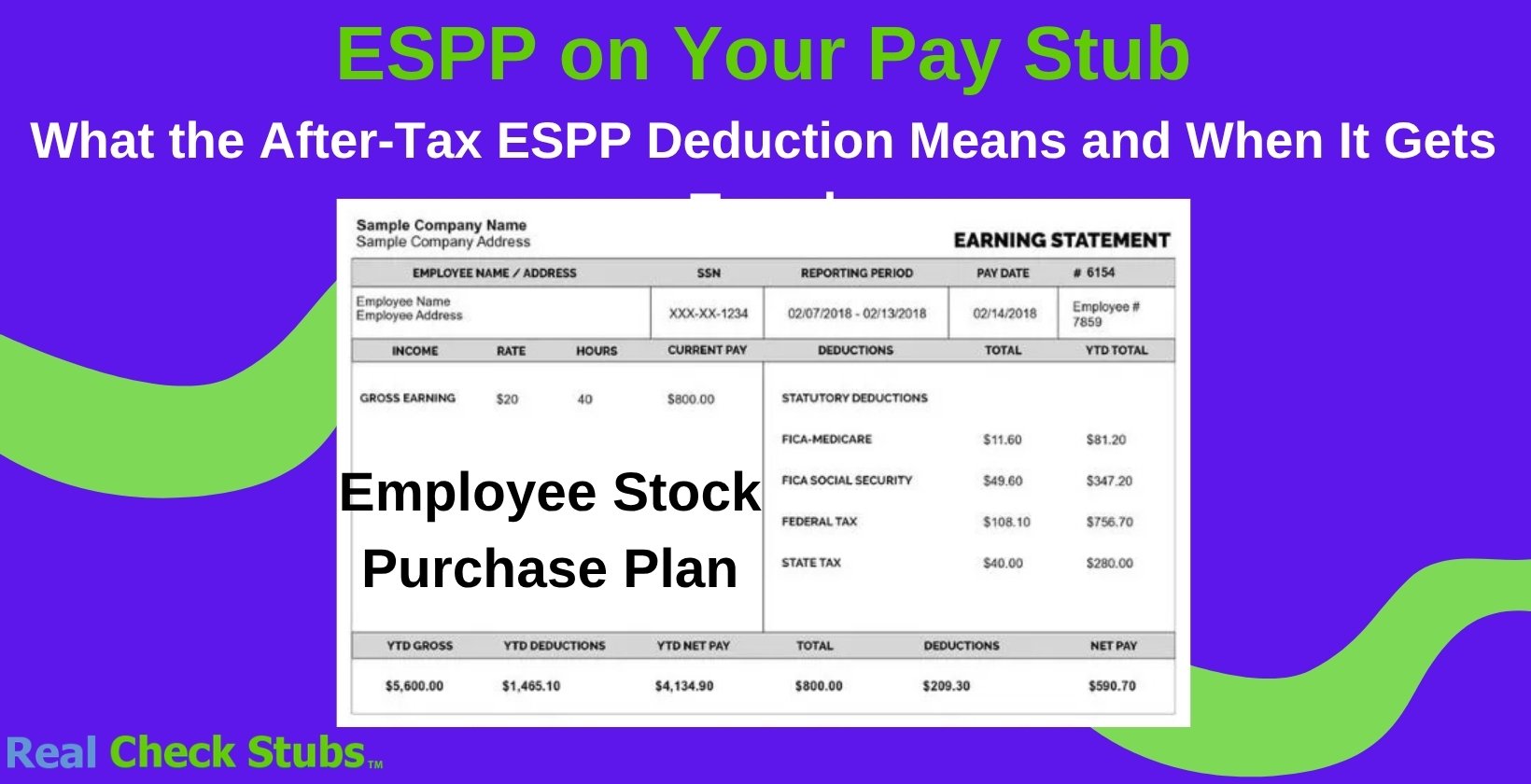
ESPP almost always sits in the after-tax or post-tax deductions block, below federal withholding and FICA. Payroll systems label it differently, which is why the same benefit can look unfamiliar on a new employer's stub.
| Label You Might See | What It Means |
|---|---|
| ESPP | Standard employee stock purchase plan deduction |
| ESPP CONTRIB / ESPP DED | Same deduction, spelled out by the payroll system |
| STOCK PURCH / SPP | Abbreviated stock purchase plan line |
| ESPP REFUND | Money returned to you, usually leftover cash after a purchase or a withdrawal from the plan |
| ESPP DD / ESPPDD | Disqualifying disposition income added to wages after you sold shares early |
| ESPP (Box 14 on W-2) | Year-end reporting of ESPP compensation income already included in Box 1 |
If you see an ESPP line under earnings rather than deductions, that is different. That is compensation income being added to your wages because you sold shares, and it is covered further down.
Is ESPP Pre-Tax or Post-Tax?
ESPP contributions are post-tax. The money is withheld from pay you have already been taxed on, which is exactly why the deduction does not shrink your taxable wages.
Compare it to a traditional 401(k) contribution, which comes out before federal income tax and lowers Box 1. An ESPP deduction leaves Box 1 untouched.
That after-tax treatment is also what protects you later. Because you already paid tax on the contribution dollars, only the discount and any market gain get taxed when you sell.
| Deduction | Tax Timing | Lowers Box 1 Wages? |
|---|---|---|
| Traditional 401(k) | Pre-tax | Yes |
| Section 125 health premiums | Pre-tax | Yes |
| HSA via payroll | Pre-tax | Yes |
| Roth 401(k) | Post-tax | No |
| ESPP | Post-tax | No |
How Your ESPP Deduction Becomes Shares
Shares are not bought every payday. Contributions accumulate across an offering period, then buy stock all at once on the purchase date.
Most plans run 6-month offering periods, though some use 3, 12, or 24 months. Two dates matter:
- Grant date (offering date): the first day of the offering period, when your purchase right is granted
- Purchase date: the last day of the period, when your accumulated cash converts to shares
The Discount and the Lookback
Section 423 plans can discount the stock by up to 15%. Many plans add a lookback, which applies that discount to the lower of the grant-date price or the purchase-date price.
The lookback is where most of the value sits. If the stock rises during the offering period, you buy at a discount to the old, lower price.
A Worked Example
| Item | Amount |
|---|---|
| Contribution rate | 10% of $5,000 gross per month |
| ESPP line on each stub | $500 |
| Accumulated over 6 months | $3,000 |
| Stock price on grant date | $50.00 |
| Stock price on purchase date | $60.00 |
| Purchase price (15% off lower price) | $42.50 |
| Shares purchased ($3,000 / $42.50) | 70 shares (fractional handling varies by plan) |
| Market value at purchase (70 x $60) | $4,200 |
| Built-in gain (bargain element) | $1,200 |
Leftover cash that cannot buy a whole share is usually refunded on a later stub or rolled into the next period. That is the "ESPP REFUND" line people sometimes spot.
ESPP Contribution Limits in 2026
Two separate caps control how much can come out of your paycheck.
The first is the federal one. Under IRC Section 423(b)(8), you cannot accrue the right to buy more than $25,000 of stock per calendar year, valued at the grant-date fair market value rather than the discounted price you pay. This figure is statutory, is not indexed to inflation, and has not changed in decades.
The second is your employer's own plan rule, usually a percentage cap on pay. Most plans allow somewhere between 1% and 15% of eligible compensation, and for many employees that percentage cap bites long before the $25,000 ceiling does.
Note that the $25,000 is measured on grant-date value, so at a $50 grant price you can accrue rights to 500 shares in a year, even if the stock later trades at $80. Plan administrators normally enforce this automatically and cut off contributions when you approach the limit.
Do You Pay Tax When the ESPP Deduction Comes Out?
No. Under a qualified Section 423 plan, nothing is taxable at the moment payroll withholds the money, and nothing is taxable when the shares are purchased.
The taxable event is the sale. That is a real advantage over most other compensation, because you control the timing.
Your employer will send you Form 3922 by January 31 for any shares transferred during the prior year. It is informational only, but keep it, because it holds the grant-date price, purchase-date price, and actual price paid that you need later.
How ESPP Is Taxed When You Sell
Everything hinges on how long you held the shares. Two clocks run at the same time, and you have to clear both.
A qualifying disposition means you sold at least 2 years after the grant date and at least 1 year after the purchase date. Miss either one and it is a disqualifying disposition.
| Qualifying Disposition | Disqualifying Disposition | |
|---|---|---|
| Holding period | 2 years from grant AND 1 year from purchase | Either test failed |
| Ordinary income | Lesser of the grant-date discount or your total gain | Full bargain element at purchase (FMV at purchase minus price paid) |
| Remaining gain | Long-term capital gain | Short-term or long-term, depending on holding period |
| Reported on W-2 | Yes, in Box 1 | Yes, in Box 1 |
| Typical outcome | More favorable | More income taxed at ordinary rates |
In both cases the compensation portion belongs in Box 1 of your W-2, and many employers also list it in Box 14 as a courtesy so you can identify it. Federal law does not require Social Security or Medicare tax on ESPP income from a Section 423 plan, so it generally should not appear in Box 3 or Box 5.
Federal income tax withholding is also not required on this income. That means a big sale can leave you owing at filing time, so consider estimated payments or an extra withholding adjustment.
The Cost Basis Trap
This is the single most expensive ESPP mistake. Brokers frequently report your cost basis on Form 1099-B as the discounted price you actually paid.
If you file it that way, you pay tax twice on the same discount, once as W-2 wages and again as capital gain. Your true basis is the price you paid plus the ordinary income already reported on your W-2.
Adjust the basis on Form 8949 using the supplemental statement from your broker and the figures on Form 3922. Keeping your pay stub records and year-end forms together makes this reconciliation far easier at tax time.
How to Check Your ESPP Deduction Is Correct
Run this check once a quarter. It takes two minutes and catches most payroll errors before they compound.
- Multiply your gross pay for the period by your elected contribution percentage. Confirm it matches the ESPP line.
- Check whether your plan uses gross pay or a narrower "eligible compensation" definition. Bonuses and overtime are often excluded.
- Compare the ESPP year-to-date figure on your stub against the balance shown in your plan administrator's portal, such as Fidelity, Computershare, E*TRADE, or Schwab.
- Confirm the deduction sits under post-tax deductions. If it appears pre-tax, flag it with payroll immediately.
- After each purchase date, verify the ESPP line resets and that any refund of leftover cash appears.
If you need clean, organized copies of your earnings history for a lender, a landlord, or your own records, our pay stub generator helps you produce accurate documentation of gross wages, deductions, and YTD totals for legitimate recordkeeping.
Common ESPP Pay Stub Problems
The Deduction Suddenly Stopped
The usual causes are hitting the $25,000 annual accrual cap, an unpaid leave of absence, or an enrollment window you did not re-confirm. Check the plan portal first, then payroll.
The Amount Changed Without You Changing Anything
If your deduction is a percentage, it moves with your gross pay. A commission month, an overtime run, or a raise will all shift the dollar figure.
An ESPP Amount Appeared in Earnings, Not Deductions
That is compensation income from a share sale being pushed through payroll so it lands correctly on your W-2. It is not extra cash in your pocket, and your net pay may drop that period if your employer withholds against it.
Your W-2 Looks Higher Than Expected
ESPP disposition income inflates Box 1 without any matching cash deposit, which surprises people every January. Cross-check Box 14, your Form 3922, and your brokerage statements before assuming an error. If you administer payroll for a small business and need to produce accurate year-end forms, our W-2 form maker generates a properly formatted statement in minutes.
ESPP vs Similar Pay Stub Line Items
| Line Item | What It Is | Tax Timing |
|---|---|---|
| ESPP | Your own after-tax money buying discounted company stock | Taxed at sale |
| RSU | Shares granted by the employer that vest over time | Taxed as wages at vesting |
| ESOP | Employer-funded retirement plan holding company stock | Taxed at distribution |
| 401(k) | Retirement contribution, pre-tax or Roth | Pre-tax: taxed at withdrawal |
| Stock options (NQSO) | Right to buy shares at a set price | Taxed as wages at exercise |
One risk worth naming. Because ESPP shares concentrate your savings in the same company that pays your salary, many advisors suggest selling on a schedule rather than accumulating indefinitely.
Frequently Asked Questions
What is ESPP on my pay stub?
ESPP is an after-tax payroll deduction that sets aside part of your paycheck to buy company stock at a discount. The money accumulates until the plan's purchase date, then converts into shares you own.
What is ESPP on a payslip?
It means the same thing as on a US pay stub: an Employee Stock Purchase Plan deduction. The label and tax treatment vary outside the US, so check your local plan documents for how the discount is taxed.
How do I declare ESPP?
You declare ESPP only in the year you sell the shares, not when the deduction comes out. The compensation portion arrives already included in Box 1 of your W-2, and you report the sale itself on Form 8949 and Schedule D.
How do I report ESPP on my taxes?
Report the sale on Form 8949 and Schedule D using the 1099-B from your broker, then adjust the cost basis upward by the ordinary income already shown on your W-2. Use Form 3922 to confirm your grant-date price, purchase price, and purchase-date value.
Does ESPP reduce my taxable income?
No. ESPP contributions are taken after tax, so they do not lower your Box 1 wages the way a traditional 401(k) or pre-tax health premium does.
References
- IRS. 26 U.S. Code § 423 — Employee Stock Purchase Plans. https://www.irs.gov/
- IRS. Publication 525, Taxable and Nontaxable Income. https://www.irs.gov/publications/p525
- IRS. About Form 3922, Transfer of Stock Acquired Through an Employee Stock Purchase Plan. https://www.irs.gov/forms-pubs/about-form-3922
- IRS. Stock Options and Employee Stock Purchase Plans. https://www.irs.gov/taxtopics/tc427
- IRS. About Form 8949, Sales and Other Dispositions of Capital Assets. https://www.irs.gov/forms-pubs/about-form-8949
- IRS. About Form W-2, Wage and Tax Statement. https://www.irs.gov/forms-pubs/about-form-w-2
- SEC Office of Investor Education. Employee Stock Purchase Plans. https://www.investor.gov

Allen Wood is an accomplished accountant with over 15 years of experience in the field.
Our all Posts