Ohio Paycheck Calculator

Wondering how much Ohio takes out of your paycheck? The good news is Ohio is one of the lighter-tax states.
As of 2026, the state income tax is a flat 2.75% on income above $26,050, with no state tax at all below that line. Add federal tax, Social Security, Medicare, and any local city tax, and most Ohio workers keep a larger share of their pay than people in higher-tax states.
An Ohio paycheck calculator guide does the math for you in seconds, and you can turn the result into a paystub right after.
Ohio sits in the Midwest and is home to about 11.8 million people. If you are new to earning or hiring here, this guide walks through the state's 2026 tax rates, payroll rules, and labor laws, then shows you how to build a clean paycheck stub once your numbers are ready.
Registering a Business in Ohio
Your first decision is the business structure. Ohio supports several types, including an LLC (Limited Liability Company), partnership, corporation, LLP (Limited Liability Partnership), and sole proprietorship.
From there, the process is straightforward:
- Register your business with the Ohio Secretary of State.
- Open a business bank account and apply for an EIN (Employer Identification Number) from the IRS.
- Register with the Ohio Department of Taxation.
- Report every new or rehired worker to the Ohio New Hire Reporting Center.
- Apply for any permits and licenses through the Ohio Business Gateway.
The online business registration filing fee is $99 for most entities.
Ohio Tax Overview
If you earn income from an Ohio source, you owe Ohio income tax, whether you live in the state or not. For 2026, Ohio uses a flat structure: 0% on the first $26,050 of income and 2.75% on everything above it. This replaces the old multi-bracket system that topped out at 3.5%.
Many Ohio cities and school districts add their own local income tax, often between 1% and 3%. Federal income tax is separate and depends on your bracket. On the sales side, the state rate is 5.75% and local add-ons average around 1.5%, putting the typical combined sales tax near 7.25%.
For tax filing, employers issue a W-2 summarizing each worker's pay and withholding, plus a W-3 that totals wages and taxes for the year. If you earn money outside of regular employment, that income is reported on a Form 1099 before you file.
Taxable Base Wage (SUI)
The taxable wage base is the maximum portion of each employee's pay that is subject to state unemployment (SUI) tax. For 2026, Ohio raised this base from $9,000 to $9,500. Once a worker's year-to-date wages pass $9,500, no further SUI tax is due on that employee.
| Year | Ohio SUI Taxable Wage Base |
| 2026 | $9,500 |
| 2025 | $9,000 |
| 2024 | $9,000 |
SUTA Rates
Ohio's State Unemployment Tax is paid by employers, and your rate depends on your experience rating and industry. The Ohio Department of Job and Family Services sets these rates each year based on your claims history and the balance of the state's unemployment trust fund.
For 2026, experienced employer rates run roughly 0.4% to 10.1%. New employers pay about 2.7%, while new construction employers pay a higher rate near 5.85%. A new rule for 2026 also adds a small employee contribution of 0.14% at certain employers carrying a negative account balance.
| Year | Ohio Employer SUI Range | New Employer Rate |
| 2026 | 0.4% to 10.1% | 2.7% |
| 2025 | 0.4% to 10.1% | 2.7% |
| 2024 | 0.4% to 10.3% | 2.7% |
FUTA Rates
The Federal Unemployment Tax Act sets a 6% rate on the first $7,000 of each employee's wages. Employers who pay state unemployment tax on time earn a 5.4% credit, which lowers the effective rate to 0.6%. Ohio is not a credit reduction state, so Ohio employers get the full credit and pay 0.6%, or up to $42 per employee per year.
| Year | Standard FUTA | Ohio Effective Rate |
| 2025 | 6% on first $7,000 | 0.6% (full credit) |
| 2024 | 6% on first $7,000 | 0.6% (full credit) |
| 2023 | 6% on first $7,000 | 0.6% (full credit) |
FICA Rates
Ohio follows the federal FICA rates, which total 7.65% for the employee share in 2026:
- Social Security: 6.2% on wages up to the 2026 wage base of $184,500. Employers match this 6.2%.
- Medicare: 1.45% on all wages, with an extra 0.9% on wages above $200,000 (single) or $250,000 (joint). Employers match the 1.45%.
Other Tax Rates
Ohio has no state disability insurance tax, so there is no state insurance deduction on Ohio paychecks. A few other state taxes can come up in daily life:
Alcoholic Beverage Tax
Beer is taxed at $0.14 per ounce up to 12 ounces, $1.50 per gallon, and $5.58 for every 31 gallons sold.
Cigarette and Tobacco Taxes
Ohio charges $1.60 per pack of 20 cigarettes.
Ohio Payroll Tax Withholding
- Federal Payroll Taxes: Employers withhold 6.2% for Social Security (on wages up to $184,500 in 2026) and 1.45% for Medicare, and they match both. The extra 0.9% Medicare tax applies to high earners over $200,000 (single) or $250,000 (joint).
- Ohio State Income Tax Withholding: Ohio does not withhold at a single flat percentage off the top. Employers use the Ohio Department of Taxation withholding tables, which factor in pay, frequency, and claimed exemptions, then settle up against the flat 2.75% rate at filing.
Ohio Paycheck Calculator
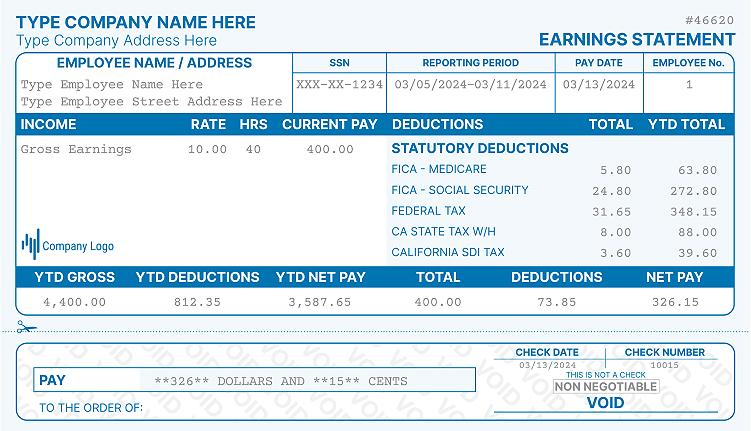
Your paycheck is your earnings after the state, federal, and local taxes are removed. A paystub shows the full picture: gross pay, each deduction, and the net pay that lands in your account.
To use an Ohio paycheck tax calculator, start with your gross monthly income. Then add your pre-tax items, such as a 401(k), FSA, HSA, LTD (long-term disability insurance), and medical premiums. Apply any post-tax deductions last, and what remains is your take-home pay.
Ohio Hourly Paycheck Calculator
For an hourly worker, the only difference is how you find gross pay. Multiply your hourly rate by the hours you worked in the period.
Say you earn $15 per hour and work 168 hours in a month. Your gross wage is $15 x 168, or $2,520. Using 2026 Ohio rates, a single filer in a typical Columbus area might see roughly:
| Deduction | Amount |
| Federal income tax (estimated) | ~$210 |
| Ohio state income tax (estimated) | ~$22 |
| Local city income tax (estimated, around 2%) | ~$50 |
| Social Security (6.2%) | $156.24 |
| Medicare (1.45%) | $36.54 |
| Take-home pay (estimated) | ~$2,045 |
These figures are estimates. Local rates vary widely, so the result in Cleveland, Cincinnati, or Columbus will differ from a lower-tax county. A calculator or a check stub tool runs the exact math for your city.
Ohio Child Support Calculator
When a parent does not live with their child, they typically provide financial support through court-ordered child support.
Ohio bases the amount on each parent's income and the number of overnights the child spends with each parent per year. For example, if one parent has the child for 183 overnights, they may cover about 50% of the support obligation. The state guidelines and a child support calculator handle the exact split once you enter both incomes.
Labor Laws in Ohio
Minimum Wage
- As of January 1, 2026, the minimum wage is $11.00 per hour for non-tipped employees.
- Tipped employees earn a minimum cash wage of $5.50 per hour, as long as tips bring total pay to at least $11.00.
- These rates apply to employers with annual gross receipts over $405,000. Smaller employers and workers under 16 follow the federal minimum of $7.25.
Overtime Pay
- Covered employees earn 1.5 times their regular rate for hours worked beyond 40 in a workweek.
Workweek and Personal Leave
- The standard workweek is 40 hours.
- Ohio has no mandatory paid sick leave law. Some employers offer it as a benefit, but the state does not require it.
Child Labor Laws
- Ohio strictly regulates the employment of minors. The specific limits depend on the worker's age and the type of job.
Important Note
Labor rules change, so check the Ohio Department of Commerce site or speak with a legal professional for the most current requirements.
Ohio Paystub Generator
An online paystub generator applies the federal, state, and local deductions and drops the results into a clean template. A tool like Real Check Stubs handles this in under a minute and helps you steer clear of fake or error-filled stubs.
Ohio Tax Resources
- Ohio Department of Taxation (collects and administers state and local taxes)
Website: https://tax.ohio.gov/
Phone: (800) 282-1780
Address: 30 E Broad St #22, Columbus, OH 43215, United States
- The Ohio Society of CPAs
Website: https://ohiocpa.com/
Phone: +1 614-764-2727
Address: 4249 Easton Way #150, Columbus, OH 43219, United States
FAQs
How much does Ohio tax on paychecks?
For 2026, Ohio applies a flat 2.75% state income tax on income above $26,050, and 0% below it. On top of that you have federal tax, Social Security, Medicare, and possibly a local city tax of 1% to 3%.
How do I calculate my paycheck after taxes in Ohio?
Start with gross pay, subtract pre-tax deductions, then remove federal tax, the 2.75% state tax on income over $26,050, any local city tax, and FICA. An online Ohio paycheck calculator does all of this instantly when you enter your details.
Is the Ohio paycheck calculator free?
Yes. Most online Ohio paycheck calculators are free and return results instantly, as long as you enter accurate pay and deduction information.
Who needs to pay taxes in Ohio?
Anyone who earns income from an Ohio source is liable for Ohio income tax, whether they are a resident or not.
Final Words
An Ohio paycheck calculator takes the guesswork out of figuring your real take-home pay, especially now that the state runs on a simple flat 2.75% rate. Once you know your numbers, a paystub generator like Real Check Stubs turns them into a professional stub in about a minute.

Kristen Larson is a payroll specialist with over 10 years of experience in the field. She received her Bachelor's degree in Business Administration from the University of Minnesota. Kristen has dedicated her career to helping organizations effectively manage their payroll processes with Real Check Stubs.
Our all Posts