How to Read a Pay Stub: Every Line Explained (With Diagram)

The deposit hit your account and it was smaller than you expected. The stub is supposed to explain why, but it reads like code: FIT, OASDI, MED, YTD. Skip those lines and a payroll mistake can ride along for months before anyone catches it. I fix that here. We'll take one real stub and go through it line by line until every number on yours makes sense.
The 30-Second Version
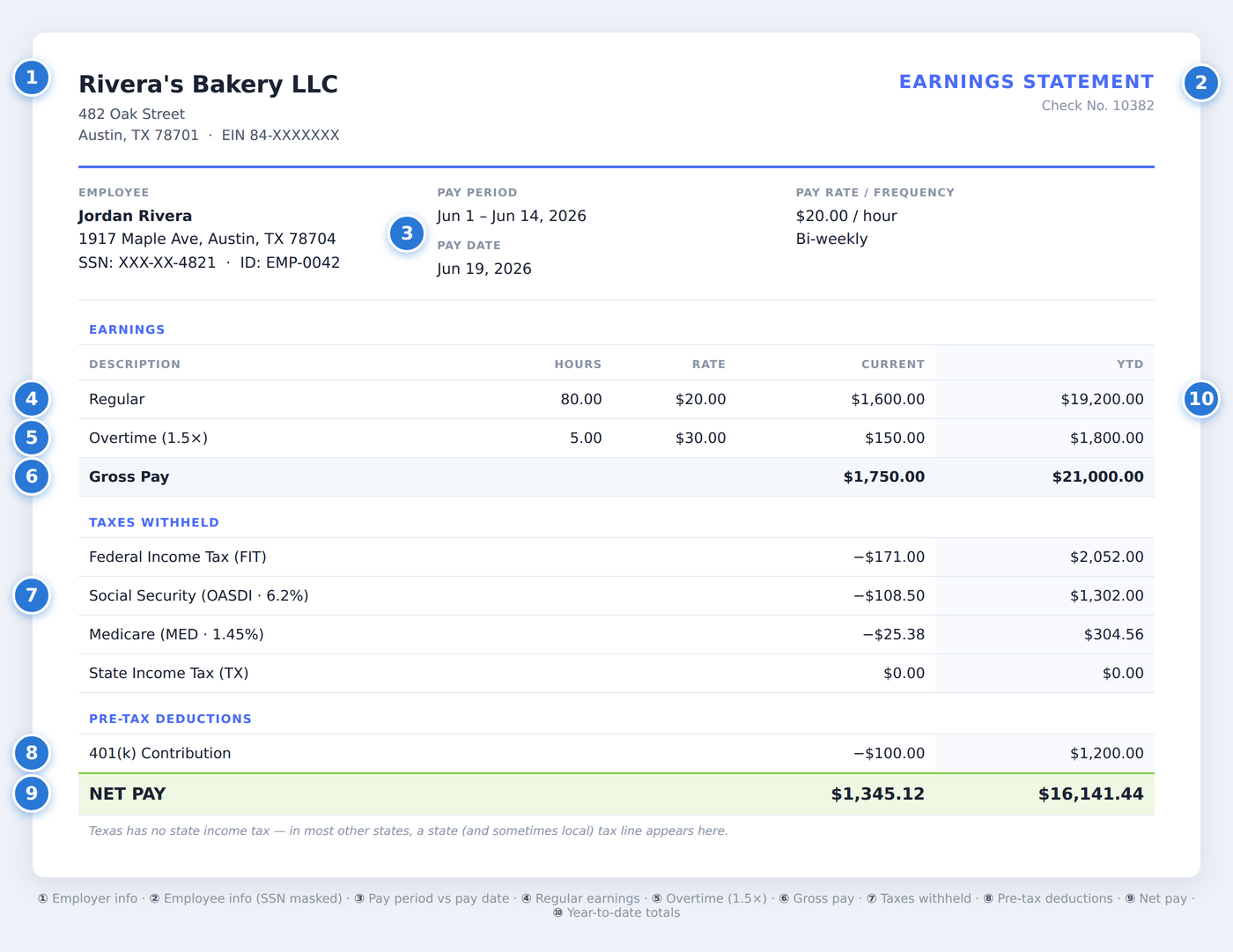
Teachers, HR teams, and publishers: you're welcome to reuse this diagram with a link to this page.
Reading top to bottom, every pay stub follows the same flow:
- Who and when. Your info, your employer's info, and the pay period.
- Gross pay. Everything you earned before deductions.
- Taxes. Federal income tax, Social Security, Medicare, and state withholding.
- Other deductions. Health insurance, retirement, and anything else you or a court signed up for.
- Net pay. What's left. This should match your deposit.
1. Employer and Employee Information
The top shows your name, your address, the last four digits of your Social Security number, your employer's legal name, and sometimes an employee ID. A stub that prints your full SSN is a security problem worth raising with payroll.
Check the addresses. State income tax follows where you live and work, so a stale address after a move can put the wrong state's tax on every check this year.
2. Pay Period vs. Pay Date
The pay period is the stretch of days the check covers, June 1 through 14 in Jordan's case. The pay date is the day money moves, June 19 here. The gap between them is processing time. Payroll needs those days to calculate hours and taxes for everyone on the roster. I explain the full timing picture, including pay cycles and check dates, in our pay period vs. payday vs. pay cycle guide.
3. Earnings: Your Gross Pay
The earnings block lists each type of pay with hours, rate, and amount. Here's Jordan's, from the diagram above:
| Earning | Hours | Rate | Amount |
|---|---|---|---|
| Regular | 80 | $20.00 | $1,600.00 |
| Overtime (1.5×) | 5 | $30.00 | $150.00 |
| Gross pay | $1,750.00 |
- Overtime pays at least 1.5× the regular rate once an hourly worker passes 40 hours in a week, under federal overtime rules. Jordan's $20 becomes $30.
- A salaried employee sees one line instead: annual salary divided by the number of pay periods. A $52,000 salary on a bi-weekly cycle prints as $2,000 per stub.
- Bonuses, commissions, tips, and paid-out PTO each get their own line, and each one is taxable.
- Lenders and landlords ask for "gross monthly income," so this block is where that number comes from. Your deposit will be smaller.
4. Taxes Withheld
Four lines do most of the work here.
Federal income tax (FIT or FWT). The W-4 you filled out at hire sets this amount, which makes it the one tax line you control. File a new W-4 with your employer to change it. A zero here surprises people every year, and our guide to why no federal tax was withheld walks through the reasons. Jordan's $171 is an illustration. Your number depends on your W-4.
Social Security (SS, OASDI, or FICA-SS). A flat 6.2% of gross, up to a yearly wage cap of $184,500 in 2026. Jordan pays $108.50 on this check. High earners see this line stop late in the year once pay passes the cap.
Medicare (MED or FICA-Med). A flat 1.45% with no cap, plus 0.9% more on income above $200,000 a year. For Jordan: $25.38.
Together these two make up FICA, 7.65% of your check. Your employer pays a matching 7.65% on top of your wages, and that match never appears in your deductions. Our FICA explainer has the full math.
State and local income tax (SIT or SWT). Nine states take nothing from wages: Alaska, Florida, Nevada, New Hampshire, South Dakota, Tennessee, Texas, Washington, and Wyoming. Jordan lives in Texas, so his line reads zero. Everywhere else this line varies with state rates, and some cities and counties add a local line beneath it.
5. Pre-Tax Deductions
These come out before taxes get calculated, so they shrink your taxable income:
- 401(k) / 403(b) retirement contributions
- Health, dental, and vision premiums, meaning your share of the plan
- HSA and FSA contributions
- Commuter benefits
Jordan puts $100 into a 401(k), which drops his federally taxable pay to $1,650. The tax savings mean that $100 contribution costs him less than $100 in take-home.
An ER prefix, like "ER Health," marks money your employer pays on your behalf. It rides along on the stub for information and leaves your pay alone. Details in our ER Health explainer.
6. Post-Tax Deductions
These come out after taxes:
- Roth 401(k) contributions, taxed now and tax-free in retirement
- Wage garnishments, court-ordered payments like child support (what garnishment looks like on a stub)
- Union dues
- Charitable payroll giving and some insurance types
7. Net Pay
One formula explains every pay stub ever printed:
Gross pay − taxes − deductions = Net pay
For Jordan: $1,750.00 minus $304.88 in taxes minus $100.00 in retirement leaves $1,345.12. The deposit should match this number to the penny. When it doesn't, start with payroll.
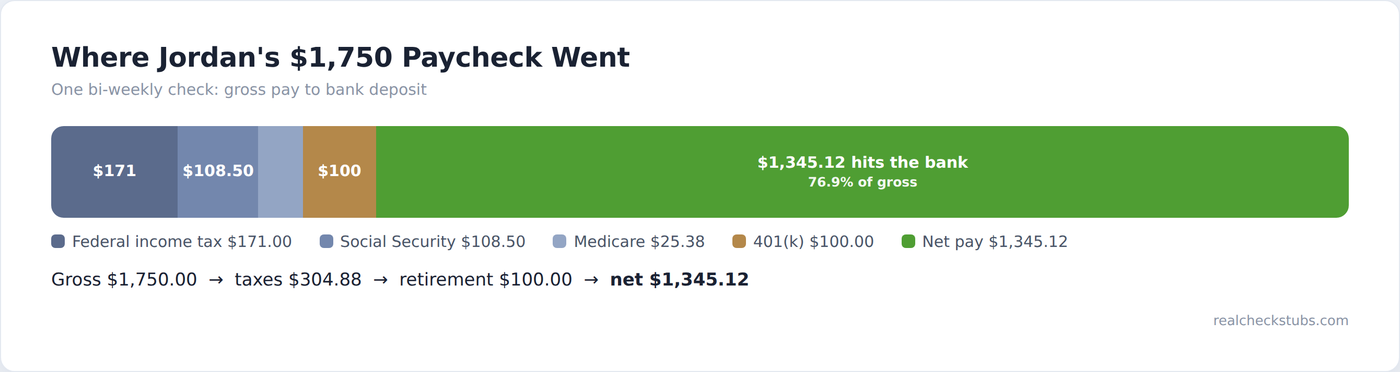
A 20 to 30 percent gap between gross and net is typical for a single filer with a benefits plan.
8. Year-to-Date (YTD) Columns
Nearly every line has a second number: the running total since January 1.
- Loan and rental applications often ask for YTD income rather than one check.
- Your final December stub's YTD gross is the number to compare against your W-2. Pre-tax deductions make Box 1 smaller, and our guide to calculating W-2 wages from a pay stub shows the reconciliation.
- A YTD number that shrinks between stubs is always an error. Flag it.
How to Get Your Pay Stub
Employers deliver stubs a few ways: printed with a paper check, downloadable from a payroll portal, or through an HR request. Federal law stays quiet on the subject, and most states require employers to provide some form of statement. If your company runs a portal you've never opened, our walkthroughs cover ADP, Walmart, Walgreens, and dozens of other employers.
Keep your own copies for at least a year, long enough to check the final stub against your W-2. Tax professionals commonly say three years, which matches the IRS lookback window.
Pay Stub Abbreviation Decoder
The 25 codes you'll see most:
| Code | Meaning | Code | Meaning |
|---|---|---|---|
| GROSS | Total pay before deductions | HSA | Health savings account |
| NET | Take-home pay | FSA | Flexible spending account |
| FIT / FWT | Federal income tax withheld | 401K / RET | Retirement contribution |
| SIT / SWT | State income tax withheld | ROTH | Post-tax retirement |
| FICA | Social Security + Medicare | LTD / STD | Long/short-term disability |
| OASDI / SS | Social Security portion | GARN | Wage garnishment |
| MED | Medicare portion | UD | Union dues |
| YTD | Year-to-date total | PTO / VAC | Paid time off balance/payout |
| REG | Regular hours/pay | HOL | Holiday pay |
| OT | Overtime | ER (prefix) | Employer-paid (stays out of your check) |
| BON | Bonus | EE (prefix) | Employee-paid (comes from your check) |
| COMM | Commission | SUI / SDI | State unemployment/disability insurance |
| LOC | Local tax |
Rarer codes like KMTCHTR, CASDI-E, FTD, and VACACC live in the full abbreviations guide.
Check Your Stub in 60 Seconds
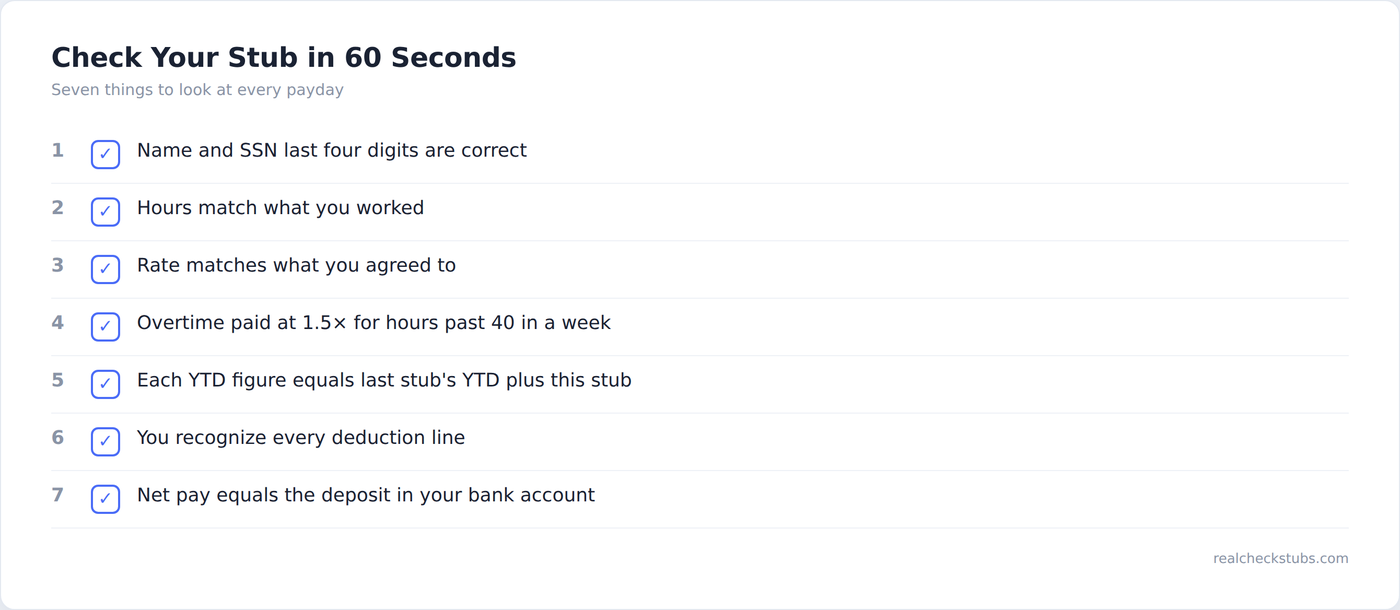
Payroll errors are common enough that a one-minute scan every payday earns its keep. Run the seven checks above, in order. Fresh errors get fixed in one cycle. Stale ones turn into archaeology.
If Something's Wrong
Go to payroll or HR first, in writing, with the specific line item. Your state's labor department handles unresolved wage disputes, and the U.S. Department of Labor covers the federal rules.
Need a pay stub instead of decoding one? If you're self-employed or your employer skips stubs entirely, you can generate an accurate pay stub in about two minutes, taxes calculated automatically, in the same layout you just learned to read.
Missing the stub itself? My pay stub portal guides cover the login steps for 39 employers and payroll platforms, and the free paycheck calculator shows what each line should come to before you compare.
Frequently Asked Questions About Reading a Pay Stub
What is the most important thing to check on a pay stub?
Check that net pay matches your bank deposit, that hours match what you worked, and that your rate is right. Those three checks catch the majority of payroll errors.
How do I know if my pay stub is correct?
Verify your identity details, hours, rate, and overtime, then confirm each year-to-date figure equals the previous stub's total plus the current amount. Finish by matching net pay against the deposit. The 60-second checklist above walks the full sequence.
What does YTD mean on a pay stub?
YTD stands for year-to-date, the running total of that line since January 1. Lenders use YTD income, and your December YTD gross is the number to reconcile against your W-2.
Why is my net pay so much lower than my gross pay?
Federal income tax, Social Security at 6.2%, Medicare at 1.45%, state tax, and your benefit deductions all come out before the deposit. For many workers the total reduction runs 20 to 30 percent of gross pay.
What does a 401(k) look like on a pay stub?
A 401(k) appears as a line labeled 401K, RET, or the plan name under pre-tax deductions, with a current amount and a YTD total. Roth 401(k) contributions appear separately under post-tax deductions.
How much tax comes out of a $300 paycheck?
FICA takes $22.95, which is 7.65% for Social Security and Medicare. Federal income tax at that pay level is often zero once the standard W-4 allowances apply, and state tax depends on where you live.
What is FICA on my pay stub?
FICA is the combined 7.65% for Social Security (6.2%) and Medicare (1.45%). Your employer pays a matching 7.65% that never appears on your stub.
Do employers have to give you a pay stub?
No federal law requires pay stubs, and most states do require employers to provide a written or electronic pay statement. State rules differ on paper versus electronic delivery.
How long should you keep pay stubs?
Keep them at least one year, until you have checked your final stub against your W-2. Many tax professionals recommend three years, matching the IRS audit lookback window.
How do I read my pay stub for taxes?
Find the tax block: federal income tax, Social Security, Medicare, and state lines, each with a current and YTD amount. Your December YTD figures should line up with your W-2, and Box 1 will be lower when you have pre-tax deductions.

Kristen Larson is a payroll specialist with over 10 years of experience in the field. She received her Bachelor's degree in Business Administration from the University of Minnesota. Kristen has dedicated her career to helping organizations effectively manage their payroll processes with Real Check Stubs.
Our all Posts